



Bollore Logistics (18 May 2021) - Problem Statement (1)
Big Image
Content
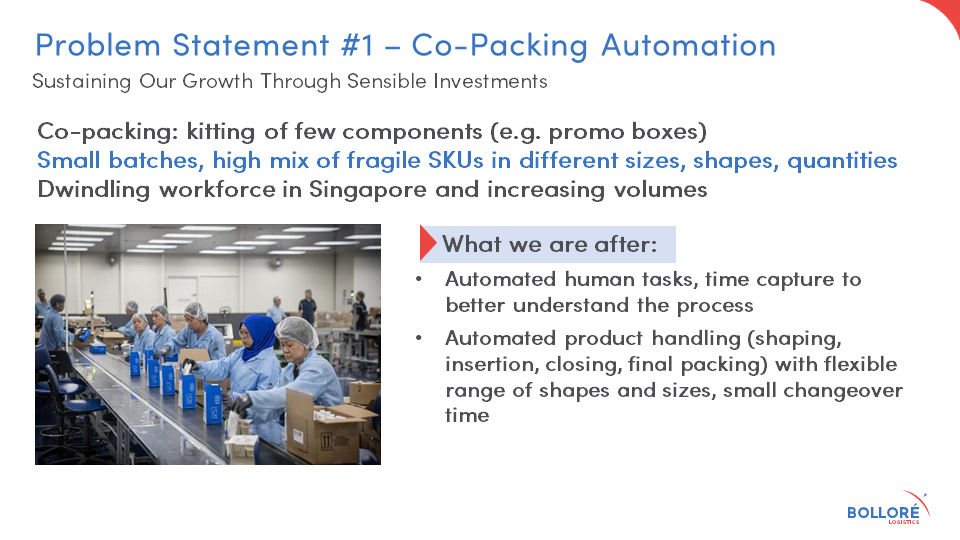
Automated human tasks, and automated product handling with small changeover time.
Content1
For startups with Technology Readiness Levels of 4 & above.
Heading
Co-Packing Automation
Logo

Category
Industry
CTA Text
COMPLETED
Sort Order
2
Infineon (31 Aug 2021) - Problem Statement (2)
Content
Objectives:
- Establish integration tools for data extraction, transformation and loading.
- Develop AI data processing platforms.
- Scalable for operations implementation.
- Enable domain experts to perform data analytics independently.
Desired Outcomes:
- Focus on predictive maintenance for automated material handling equipment.
- To package prototypes into a suite of recommended platforms and tools.
- Develop AI algorithms related to the project scope.
- AI SMART Discovery: Demonstrate capability for prototype analytics for the layman.
Current Limitations:
- Problem centric data analysis: Engineers must analyse a voluminous amount of data for actionable insights through various data sources (OEE, yield, product data & recipes, machine alarms, etc.).
- High effort, time and subject matter knowledge are required for effective cause and effect analysis.
Heading
AI SMART Discovery for Semiconductor to Identify Improvement Opportunities
Logo

Category
Industry
CTA Text
COMPLETED
Sort Order
2
Bollore Logistics (18 May 2021) - Problem Statement (2)
Big Image

Content
Alternative transport modes, fuels, packing materials & end-to-end services.
Content1
For startups with Technology Readiness Levels of 4 & above.
Heading
Greener Supply Chain
Logo

Category
Industry
CTA Text
COMPLETED
Sort Order
2
Bollore Logistics (18 May 2021) - Problem Statement (3)
Big Image
Content
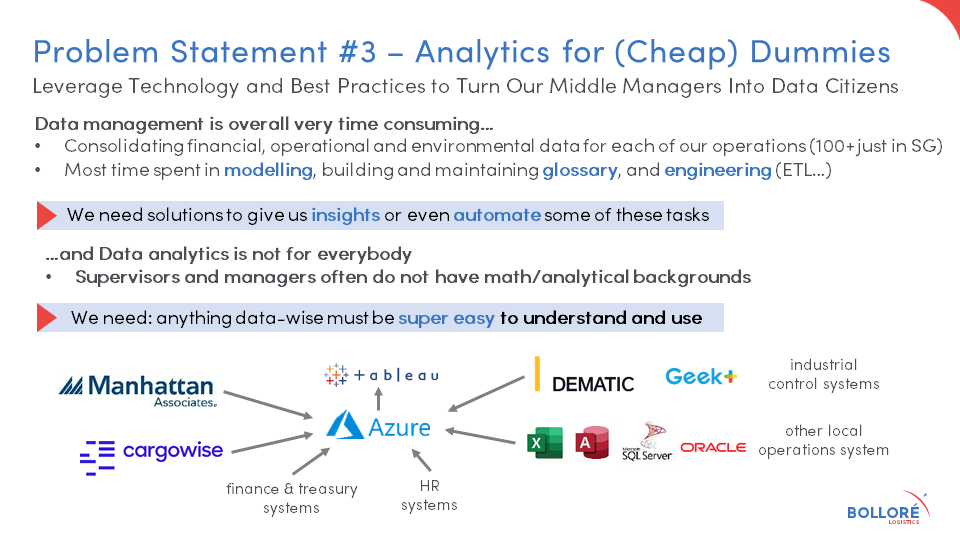
Technology and best practices to turn our middle managers into data citizens.
Content1
For startups with Technology Readiness Levels of 4 & above.
Heading
Analytics for (Cheap) Dummies
Logo

Category
Industry
CTA Text
COMPLETED
Sort Order
2
Bollore Logistics (18 May 2021) - Problem Statement (4)
Big Image

Content
Perfect low-code platforms to capture more relevant data and improve efficiency.
Content1
For startups with Technology Readiness Levels of 4 & above.
Heading
Digitising 100% Analog People
Logo

Category
Industry
CTA Text
COMPLETED
Sort Order
2
Infineon (31 Aug 2021) - Problem Statement (1)
Content
Objectives:
- Automate tasks assignment and prioritisation based on technical requirements and technicians’ profiles.
- Optimise execution with a grouping of tasks to improve efficiency.
- Predict the demand vs supply and forecast the overtime planning.
- Identify the technical competency gap among technicians.
Desired Outcomes:
- Over 34 technicians with different skillsets for operation and engineering tasks are complex and vary widely, from logistical units collection to equipment setup.
- To have a one-stop solution platform between managers, engineers and technicians.
- Interactive solution on a mobile device for technicians to receive notifications and report efficiently.
- If the execution of tasks can be on auto-pilot mode and optimised continuously driven by data analytics, this would significantly improve work efficiency.
Current Limitations:
- Engineers need to manually book the necessary resources, including equipment and technicians’ availability.
- Independent systems are used to check and book different resources, e.g. equipment booking, technician scheduling, engineering samples, etc.
- Manual and tedious effort on engineers to communicate, cross-check, and set priorities with managers and teammates.
Heading
Technical Resource Optimisation (Engineering Tasks) to Improve Work Efficiency
Logo

Category
Industry
CTA Text
COMPLETED
Sort Order
2
Indorama Ventures (26 Apr 2022) - Problem Statement
Content
Indorama Ventures is currently building the recycling infrastructure to close to loop for PET bottles. By using used PET bottles as a feedstock to make new bottles, this increases the value for these waste products and in turn de-risks investments in collection and sorting.
Objectives:
Indorama Ventures would like to explore innovative approaches which can address the following problems:
- Creating a higher demand for fully traceable plastic feedstock from ethical sources
- Increasing the amount of funding committed to waste management solutions
- Improving market segmentation by waste type
- Increasing the amount of long-term plastic off-take agreements between large buyers of plastic feedstock and waste collection entities
Heading
Improving Supply Chain Ethics, Traceability and Segmentation
Logo

Category
Industry
CTA Link
https://share.hsforms.com/1K4P_XrtmScG6Nhmf2yF17g1szrj
CTA Text
APPLY
Sort Order
1
Bosch Rexroth (31 Aug 2021) - Problem Statement (1)
Content
Objectives:
- To help establish fully interconnected and digitised smart factories
- Data to be extracted from legacy machining data/throughput
- Data within legacy machines/systems can integrate with external condition monitoring systems into one complete dashboard
Desired Outcomes:
- Key users are management and shop-floor personnel.
- One current method to obtain data from legacy machines is to introduce sensors in a non-invasive way to extract data for visualisation and analysis.
- However, there are still crucial data of these legacy machines or data from their Manufacturing Execution system that are still not retrievable.
- The limitation to the add-on sensors is that they cannot generate data to the needs of business owners fully.
Current Limitations:
- Costly and unjustifiable to replace existing legacy machines/systems (e.g. CNC/laser cutting).
- Lack of standard IoT communication protocols like MQTT and OPC UA.
- External sensors can only fulfil a partial wish list of business owners – mainly on reducing downtime and saving wastage costs.
- Crucial data like cutting speed, machine uptime, and throughput are also needed for OEE.
Heading
Data Collection from Legacy Systems
Logo

Category
Industry
CTA Text
COMPLETED
Sort Order
2
Bosch Rexroth (31 Aug 2021) - Problem Statement (2)
Content
Objectives:
- The purpose of i4.0 implementation is to increase productivity or promote process transparency.
- To convince and attract the decision-makers / top management.
- Provide a cost-benefit analysis in this i4.0 transformation process to address and educate the benefits of i4.0 implementation and that it should be of high priority.
- Lower the cost of implementing new technologies.
Desired Outcomes:
- The reasons for the reluctance to bring operations to the Internet/Cloud are often security and cost.
- There is currently no one-size-fits-all solution that can be easily applied to companies for a large scale internal review to produce the cost-benefit report for consideration to move operations to the Internet/Cloud.
- There is also no ability to effectively visualise these benefits and present data coherently to address cost and security concerns.
Current Limitations:
- i4.0 implementation can consist of various technologies/services, which can be costly overall.
- Despite the time and effort spent, the solution proposed may not yield positive results or be up to the business owner’s expectations.
- No ability to effectively visualise benefits – business owners cannot gauge the results / ROI.
- Difficult for a large-scale internal review to produce a cost-benefit report.
Heading
Cost and Effort Analysis for i4.0 Implementation
Logo

Category
Industry
CTA Text
COMPLETED
Sort Order
2