Bollore Logistics (18 May 2021) - Problem Statement (4)
Perfect low-code platforms to capture more relevant data and improve efficiency.
For startups with Technology Readiness Levels of 4 & above.
Perfect low-code platforms to capture more relevant data and improve efficiency.
For startups with Technology Readiness Levels of 4 & above.
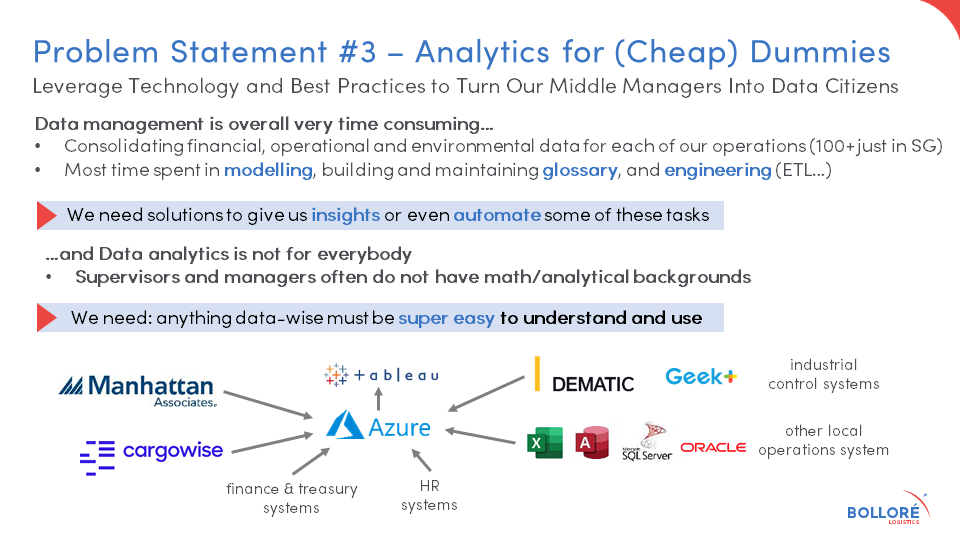
Technology and best practices to turn our middle managers into data citizens.
For startups with Technology Readiness Levels of 4 & above.
Alternative transport modes, fuels, packing materials & end-to-end services.
For startups with Technology Readiness Levels of 4 & above.
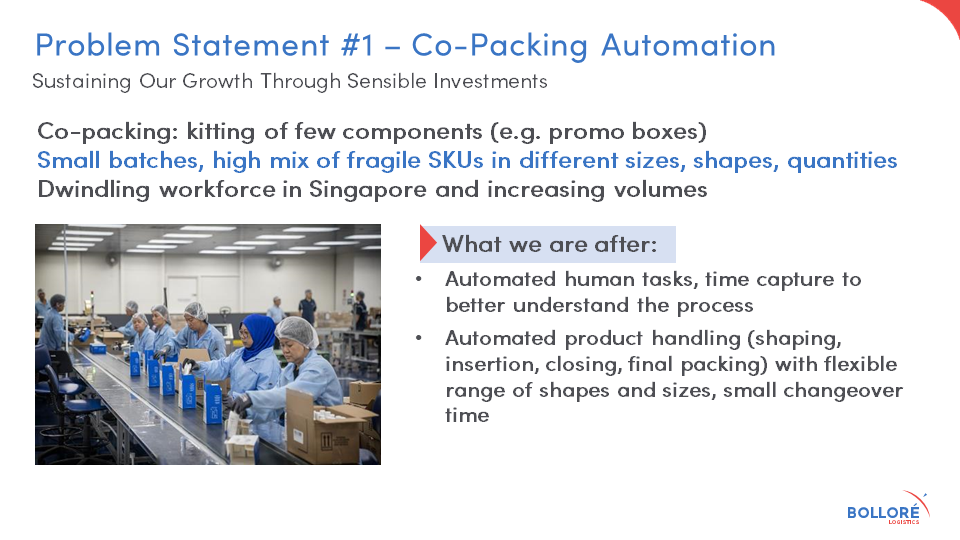
Automated human tasks, and automated product handling with small changeover time.
For startups with Technology Readiness Levels of 4 & above.
CPF Thailand is looking for a renewable energy solution for their farms and factories. The solution has to be able to generate or store enough energy to power the farm and factory for 24 hours a day with a sound financial feasibility. This aligns with the group’s holding policy to help CP Group achieve carbon neutrality.
Objectives:
To identify a renewable energy solution to power their farms and factories.
CPF Thailand has identified the following potential solutions to their problem but is open to all other ideas.
Working Model:
After partnering with selected startups, CPF Thailand will test solutions and co-develop a prototype or a POC before testing the solution at scale in a real environment to measure its business impact.
As part of the Capitaland Master Sustainability Plan, The Ascott is committed to reducing water and energy use over the next few years. There is an increasing need for the group to find solutions that can address the needs of the properties that Ascott operates globally. The properties range from Serviced Residences, Rental Housing, Hotels, Senior Living Estates and Student Accommodations.
Objectives:
To find a solution that will help Ascott-operated properties reduce water and/or energy usage.
Working Model:
If possible, a charging model based on a revenue share where the vendor takes a cut out of the savings made from the utility bill. Allowing properties to implement easily without incurring large upfront CAPEX.
As part of the Capitaland Master Sustainability Plan, Ascott is committed to reducing waste over the next few years. There is an increasing need for the group to find solutions that can address the needs of the properties that Ascott operates globally. The properties range from Serviced Residences, Rental Housing, Hotels, Senior Living Estates and Student Accommodations.
Objectives:
Because each Ascott property is on average 200 rooms, and does not operate F&B, the scale of the property does not justify the purchase of expensive equipment that costs tens of thousands of dollars.
The Ascott is looking for a solution that will help Ascott-operated properties with at least two out of four of the following:
Working Model:
The solution should be lightweight and if possible, offered on the as-a-service model.
Objectives:
To identify opportunities within the global availability of more than 1 billion tonnes of agrifood by-products (such as husks, hulls, bran, germ, etc) being under-valorised in terms of nutrients or components and going to waste.
Working Model:
Bühler group has identified three key opportunity areas
Indorama Ventures is currently building the recycling infrastructure to close to loop for PET bottles. By using used PET bottles as a feedstock to make new bottles, this increases the value for these waste products and in turn de-risks investments in collection and sorting.
Objectives:
Indorama Ventures would like to explore innovative approaches which can address the following problems:
Currently, TES receives a large amount of electrical and electronic equipment in their original packing in pallets or boxes. These pallets need to be unpacked and sorted into unique waste streams.
Some unique products will then have to be further de-manufactured, disassembled or dismantled into their individual components materials which may involve the removal of casings, screws, etc.
The current process is manual and labour intensive, and therefore time consuming, costly and error prone. The effectiveness and efficiency are also currently heavily dependent on the competence and capability of individuals.
Objectives:
TES would like to explore automating whole or part of the current process to improve efficiency. As there is a broad range of non-homogenous packaging, materials and products received, they are looking to define a standard process for this.
TES has identified some potential solutions to this problem.