

Meet the humans behind the bots
Tue, 08/25/2026 - 12:00
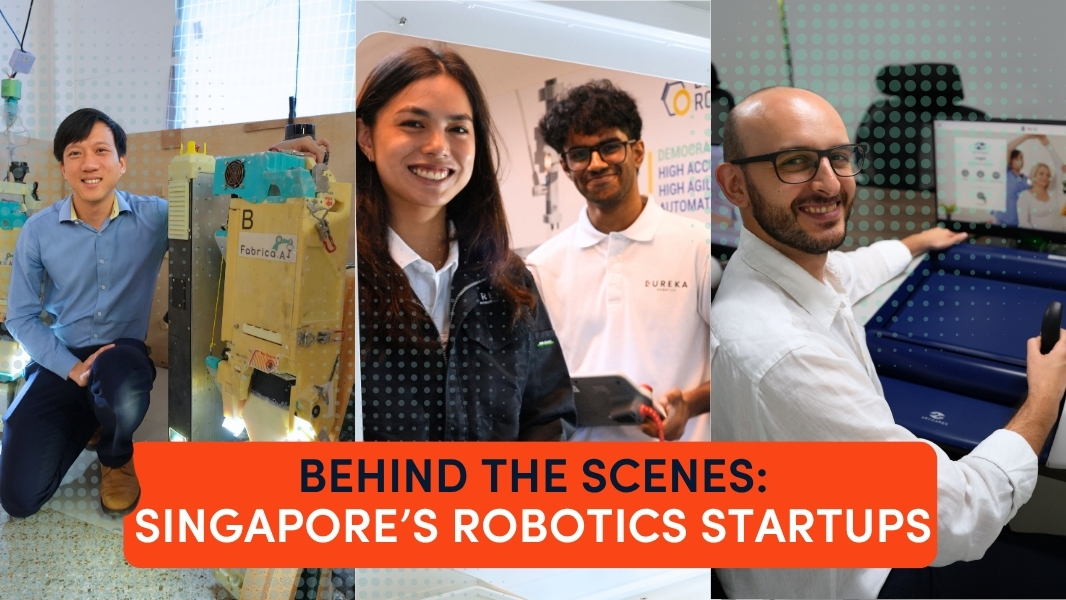
3D picking with AI, a gamified rehabilitation device and an autonomous tile-grouting robot. These are just some of the innovations being built by robotics startups in Singapore. But what does it actually take to bring these robots to life? We go behind the scenes with three robotics startups to meet the people building them, find out what they do, and hear how they found their way into robotics.
These startups are part of our Tech Walk series. Follow us on social media for more information about upcoming opportunities to visit the startups.
Building “brains” and “eyes”
Eureka Robotics’ tech is all about helping robots “see” and figure out what to pick up. Their 3D camera spots the objects, while a controller tells the robot what to do. We chat with Chinmay Prasad and Jodie Ooi, two of the people behind the tech, to find out how it all comes together.

Robotics engineer Jodie Ooi and software engineer Chinmay Prasad in front of Eureka’s demo arm.
Q: What do you work on at Eureka?
Chinmay: I work on our core product stack - the Eureka 3D Camera and Eureka Controller. The 3D Camera uses AI-based stereo vision to generate accurate point clouds without needing complex hardware. We also work on deep learning models for computer vision - object detection, classification, and pose estimation - plus setting up a pipeline for synthetic data generation. I work on the development of our motion planning algorithm and device drivers so the Eureka Controller can integrate sensors like force control and guide robots to pick and place with high precision.
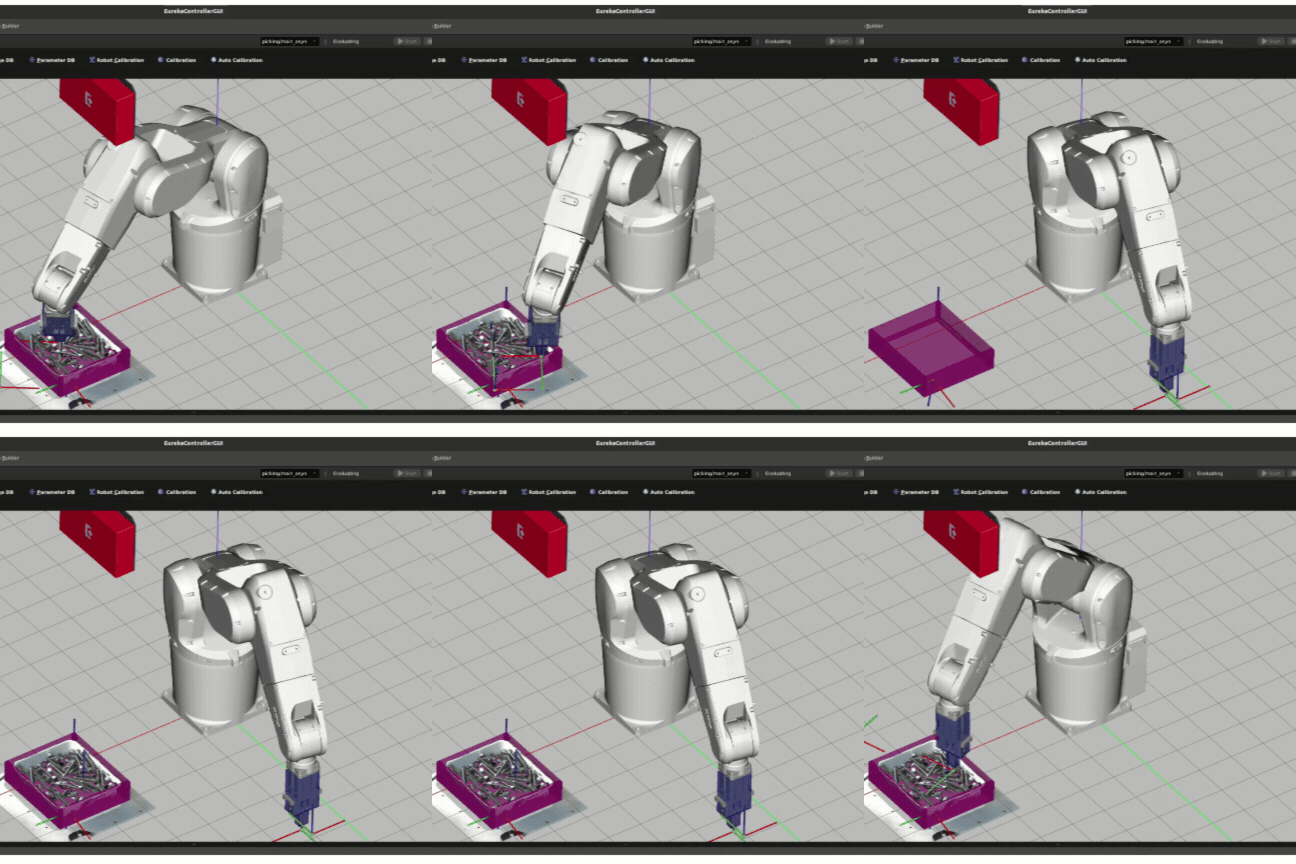
Eureka's software in action
Jodie: I'm on the Applications Team, where I take robotics projects from initial scoping through deployment and support. Some applications call for micron-level accuracy in picking and placing, so we work with a range of industrial devices — lasers, force sensors, and more — alongside the robots themselves. There's a very high degree of precision required. Recently, I also had the chance to travel to the US to deploy a solution for the aerospace industry — a system we built at our Singapore headquarters that automates key business processes for the client.
Q: What is something cool about the tech that more people should know about?
Jodie: We were featured on The Tonight Show Starring Jimmy Fallon! But our technology and capabilities have come a long way since then, though. Our roots trace back to robotics and AI research from NTU Singapore, MIT, and the University of Tokyo, and we've grown into a team with offices in Singapore, USA, Japan and Vietnam. We develop the entire cell in-house, from the 3D design, manufacturing to electrical works. We have our own mechanical engineering team which works closely with the software engineering team to integrate the program into robots.

Chinmay demonstrates Eureka’s AI Vision Software, designed to be easy to use without coding or advanced technical skills.
Q: How can someone prepare for a career in robotics?
Chinmay: I did computer science in university, and I didn't have any robotics background until my Summation internship when I joined Eureka. When you are interning in a startup, there will be opportunities to work a really broad spectrum of things. For instance, I worked with the robot itself which was quite different for me. You should always try to learn more and not just stick to what you know.
Jodie: Joining robotics clubs, anything where you actually get hands-on experience with robotics projects teaches you more about real world problems such as debugging and building a system rather than just learning from textbook tools. Of course, having the foundation in maths, algebra, calculus, physics, and coding is crucial because robotics sits at the intersection of all these fields of study. I actually wasn't planning on going into robotics. I studied biomedical engineering but having the engineering foundation helped me navigate the steep learning curve when I first joined the team at Eureka.
Gamifying rehab robotics
Articares develops intelligent rehabilitation robots by embedding expert physical therapy skills and gamifying the process of rehab to target specific training domains. Their technology supports patients undergoing neurorehabilitation and active ageing programmes because the bots can assess a patient in real time and adapt therapy accordingly. We speak with Chief Operating Officer of Articares, Bernardo Noronha, to understand more about the technology.
Q: Tell us more about the technology that Articares has developed.
Bernardo: Articares specialises in embedding physical skills into robotics, which we call embodied AI. We take complex human motor skills, including therapist skills, and translate them into robotics so the robot can assess a patient in real time and adapt the therapy accordingly.
Because the intelligence is software-driven, one device can support multiple conditions and therapy domains, while continuously expanding its capabilities over time.

Bernardo with ReHandyBot and the game Atom Rush, which targets multi-joint motor coordination.
Q: Which parts of the technology did you work on?
Bernardo: My background is in robotics and neuroengineering, so I have been applying my understanding of both the technology as well as the clinical needs, to come up with meaningful features and products. Azhar, who heads our Product Development department, then converts the requirements that my team sets into medical-grade products. He's the real star in the development, as he was responsible for turning a lab prototype more than 10 years in the making into a medical device that is approved for medical use internationally, complying with regulatory standards such as CE Mark, FDA, HSA (Singapore), NMPA (China), among others.

Muhammad Azhar, the Head of Product Development at Articares, poses with H-Man.
Q: What is something really cool about what the team has achieved?
Bernardo: I think the most interesting part about what we do lies in figuring out where technology can have the most impact, and how that dictates our product development. You can have the most advanced tech in the world, but if it has no place in the market, or if you can’t get end-users to deploy it, then it will have no impact. That is what led us to create technology that has applications in the entire continuum of care, where pain points vary wildly - in the hospital, in community-based settings such as nursing homes and day rehab centres, and even directly in people’s homes.
Q: What should aspiring students consider when embarking on a career in robotics?
Bernardo: Build strong fundamentals, build things, and understand the problem you're solving.
Robotics brings together mechanical engineering, electronics, software, AI and human interaction. But technical ability alone isn't enough – you need to understand how your technology fits into a real-world workflow and creates value for the person using it.

Filling in the gaps
Using Computer Vision and Robot Operating System (ROS), Fabrica AI designed a compact and precise grouting robot from scratch. The robot is fully autonomous and is able to fill up the grout in all the grout lines in a particular room. We speak with Keefe Wayne Teo, co-founder of Fabrica AI to find out more about the technology.
Q: Tell us more about the technology that Fabrica AI has developed.
Keefe: We invented our tile grinding robot from scratch, it uses ROS 2 as the main software and on top of that, we invented our own hardware mechanism instead of using a commercial arm off the shelf.
We wanted it to be very simple for users to just load water, press the start button, and then demarcate the boundary with red tape if there are no walls. The robot figures everything else out on its own via the LiDAR which recognises where walls are and the camera which recognises where the grout lines and red tape are.

Fabrica AI’s tile grouting robot.
Q: What is something cool about the tech that most people don’t know about?
Keefe: The most surprising feature is the fact that you do not need any prior setup. The robot doesn't need any prior information of the room. Even after I say single-button operator, and that there’s no need for a floor plan, people are surprised. They ask, "Do you connect to Building Information Modelling (BIM)? Do I need to tell the robot where to go?”
This was the target since day one. It had to be super simple for workers to use such that there is no friction involved while using it. They don’t even need to learn how to use an app to operate it.
Q: How can aspiring students prepare for a career in robotics?
Keefe: Internships are one way, another way is to have a side project. Just to have a simple robotics dev kit, and then explore from there. No better way for students to learn other than learn while doing.

Keefe with Fabrica AI’s 5th iteration of the tile grouting robot.
Trending Posts
- How Leaders Can Turn AI Adoption into Lasting Transformation
- AI can fix your code, but it cannot fix bad architecture decisions
- Why some chip technologies make it to production - and others don't
- As space cybersecurity lifts off, talent and investment are key fuels
- The future of building inspections can’t stay manual. Meet the startup changing that.