

AI can fix your code, but it cannot fix bad architecture decisions
Fri, 06/26/2026 - 12:00
AI can now turn a prompt into working code within minutes. But writing the code is only one part of building a product.
It can create a login feature, connect databases or automate a workflow. What it cannot decide for you is whether those pieces should be connected that way, which trade-offs make sense, or what might break when real users arrive.
That is where Techies’ Roast My Tech Stack comes in.

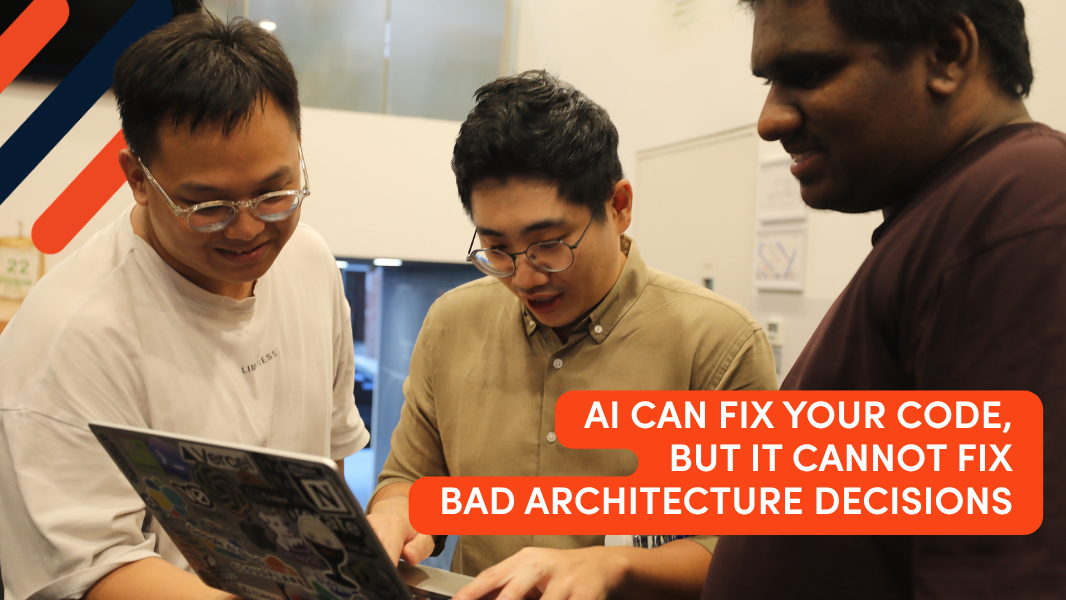
Builders, presenters and regulars from the Roast My Tech Stack community gather at SGInnovate’s 32 Carpenter Street space.
Started by Leong Han Wai, better known as Han, the series gives builders 15 minutes to bare it all: what they are building, the architecture behind it and the roadblocks they face. The audience then has another 15 minutes to question everything from the code architecture to the goal of the project, and suggest other ways it could be built better.
“Ultimately, the gap we are filling is providing that “third space” for developers to learn, upskill and grow together,” Han shares.
SGInnovate supports Roast My Tech Stack by providing a space for the community to meet each month. We spoke to Han about why he started the series, why good architecture still matters in an AI-assisted world and what really happens when a builder agrees to be “roasted”.

Leong Han Wai (Han), founder of the Techies community, at a Roast My Tech Stack session.
What made you start Roast My Tech Stack?
Han: Most events fall into one of two extremes: high-level thought leadership or 101-style hand-holding. While both have their place, developers and builders looking for deep technical substance were largely left out of the equation.
We wanted to change that by facilitating actual technical discourse. The role of a software engineer has shifted from just writing code to designing architecture and systems. Roast My Tech Stack was born specifically to host conversations around system design and architecture.
Leong Han Wai (Han)Ultimately, the gap we are filling is providing that “third space” for developers to learn, upskill and grow together.
The word “roast” can sound intimidating, but the sessions seem more curious than brutal. What does a good roast actually look like in the room?
We deliberately choose quirky, slightly provocative names for our event series to create a sense of playfulness. My personal belief is that learning and exploring new technology should be fun!
It is about asking targeted questions to unpack the thinking behind specific decisions, then mapping out what those decisions might lead to later.
We saw a perfect example during a recent session. A Product Manager in our community, was building Care Compass, an app to direct caregivers to the right support resources.
She was struggling to get accurate results while crawling multiple data sources and used the session to ask for help. The audience stepped in with precise suggestions to address gaps in the product’s architecture.
That was a hugely gratifying moment for me as it was exactly what I had envisioned for Techies: builders helping builders grow.
Who is Roast My Tech Stack for?
Our events are for anyone who wants to go deeper into understanding how technical systems work. While our main community started with a group of hardcore developers, we quickly expanded to attract other crowds who want to build their technical muscle.
We now have active community members who do not come from a traditional tech background at all but because they have been exposed to the raw, unfiltered conversations in our rooms, they are now fully comfortable holding high-level technical discussions.
I notice that people often flinch at the idea of getting “technical” and immediately dismiss it as something that is not for them. But being technical is a spectrum, not a binary one or zero.
With AI helping more people write code, what do builders still need to understand for themselves?
Understanding your intended outcome and conveying it clearly is an essential skill. Builders also need to know which third-party technologies or tools should be used together.
Contrary to popular belief, you should not just ask an AI to code everything from scratch. You need to know how to orchestrate the pieces. AI will generate whatever you ask for, but it will not understand the subtle, real-world context behind the decision. That could mean choosing a specific authentication service because of enterprise compliance, or opting for a simpler tech stack because your team’s current velocity matters more than theoretical scalability.
Those decisions still sit with the builder.
The room brings together people with very different levels of technical experience. How do you keep the conversation technical without making it too basic or too niche?
We introduced a dedicated role for every session: the Knowledge Keeper.
This person captures and summarises the main technical learning points throughout the night. The summary serves two purposes. It preserves the knowledge so people can revisit it later or catch up if they miss a session. It also translates complex discussions into something more accessible.
We deliberately keep the environment friendly and casual, too. Questions of all levels are allowed.

The community coming together to share resource and AI Credits.
Complete this sentence: AI can fix your code, but it cannot fix ________.
AI can fix your code, but it cannot fix bad architecture decisions.
That is the opening line of our event page, and it holds a lot of truth.
Sure, AI can debug syntax errors, churn out code or spin up a quick application. But it cannot design a seamless user experience, inherently feel a user’s pain points or reinvent business workflows without understanding local compliance, risk and governance.
To solve those problems, you need a builder steering the ship.
It all boils down to architectural decisions: how you design the system, the user experience flows you choose to describe to your AI agents and the specific tech stack you bring in to smooth out operational friction points.
Interested in joining the next conversation?
Explore SGInnovate’s upcoming events, including the next Roast My Tech Stack session, and register to meet fellow builders, hear what they are working on and put your own technical decisions to the test.
Trending Posts
- How Leaders Can Turn AI Adoption into Lasting Transformation
- AI can fix your code, but it cannot fix bad architecture decisions
- Why some chip technologies make it to production - and others don't
- As space cybersecurity lifts off, talent and investment are key fuels
- The future of building inspections can’t stay manual. Meet the startup changing that.