

How Leaders Can Turn AI Adoption into Lasting Transformation
Fri, 06/26/2026 - 12:00
Professor Naomi Haefner of IMD explains why lasting AI transformation depends on changing how organisations work, make decisions and build new capabilities.
Many organisations already have access to AI tools. Employees are using AI assistants and chatbots, while teams are setting up testbeds to see where generative AI can improve workflows or help people work more effectively.
Access, however, is only the starting point.
For Professor Naomi Haefner, Professor of Artificial Intelligence and Innovation at IMD, one of the biggest misconceptions is that AI transformation is primarily a technology challenge.

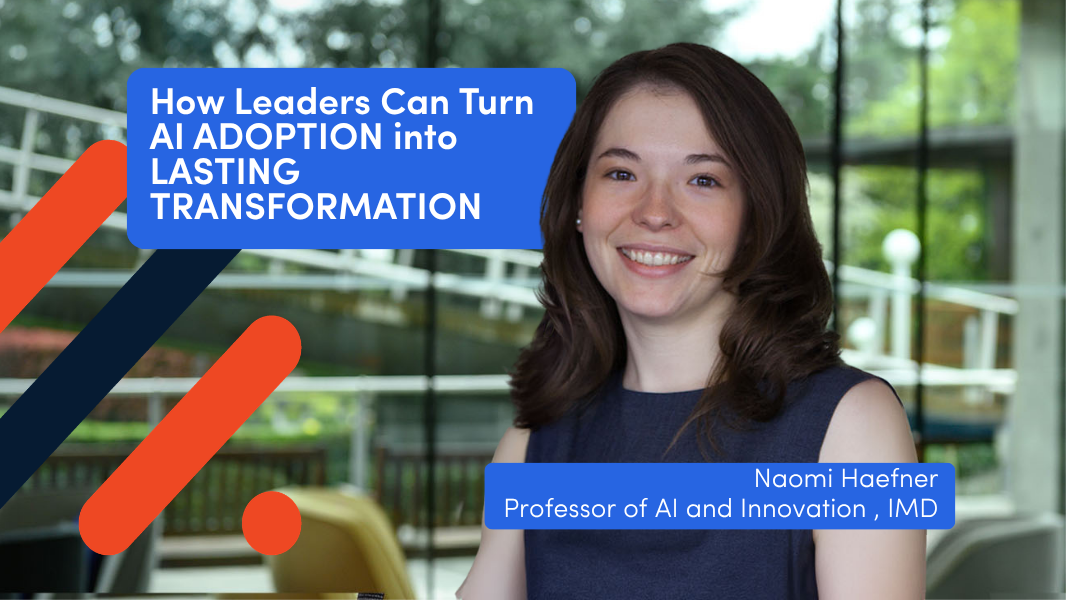
Professor Naomi Haefner is Professor of Artificial Intelligence and Innovation at IMD, where her work focuses on AI strategy, organisational design and leadership decision-making.
“It is really about the operating model: how work flows, who decides what, and where accountability sits,” she says. “The technology is rarely the binding constraint.”
Haefner researches how AI is changing innovation strategy, organisational design and leadership decision-making. At the IMD x SGInnovate AI Transformation Masterclass, she worked with founders and leaders from the Deep Tech community to examine what it takes to move beyond isolated use cases and embed AI into the way an organisation operates.
Differentiating AI activity from AI value
The number of pilots underway may look encouraging, but it does not tell leaders whether AI is creating value. “The hardest challenge is measurement,” Haefner says. “Activity is easy to measure. Truly assessing value creation is hard.”
A better measure is whether AI has improved the quality of a decision or changed how work gets done. That is harder to assess, especially when leaders are still learning where generative AI can make the greatest difference.
Many organisations stop once a use case has been proven, instead of embedding it into a live workflow or making it reusable across the business. “Most companies tend to stall at proving,” Haefner observes. “Transformation begins when they commit to the other two, and that’s where the real organisational design work sits.”
There is little precedent to follow. Leaders are making decisions about roles and workflows without an established model to draw from, which is why Haefner believes organisations need to take a more scientific approach.
Test the idea. Watch what happens. Learn from the result.
Not every experiment will work, and that is part of building a better understanding of where AI creates real value.
Define responsibilities from the start
Leaders need to know what they want AI to achieve. Governance should manage genuine risks without stopping teams from testing new ideas. Once a pilot becomes part of a live workflow, responsibility for the outcome must also be clear.
“The common instinct is to chase a better model,” Haefner observed, “that is almost never where companies are actually stuck.”
An organisation may have a capable model but no agreement on how employees should use its recommendations. There may also be uncertainty over who is responsible when the output is wrong or conflicts with human judgement.
These decisions cannot sit with the technology team alone.
“The moment it is handed to IT alone, or parked with a single Chief AI Officer on the side, it stays a technology project and never changes how the business works,” Haefner says.
Senior leaders need to set the direction and resolve the trade-offs involved. Business units must own the outcomes because they understand the work that needs to change. Technology and data teams enable that shift.

Professor Naomi Haefner challenges participants to think harder about what AI pilots are really testing, and what it takes to turn experimentation into meaningful change.
Professor Naomi HaefnerPut ownership where the decisions and the accountability already sit.
Lasting transformations come from baby steps
Organisations still need the right technical foundations. Their data must be accessible, and the infrastructure and models need to be reliable enough for real use. Haefner calls this the organisation’s “AI backbone”.
AI may surface wider issues that were already holding the organisation back, but Haefner does not recommend trying to solve everything through one large overhaul. "Define your AI mission, where you want to be, then build a plan that gets you there in small, deliberate steps.”
Formal training can help teams build a shared understanding of the technology, but lasting capability develops through practice. Employees who work closely with a process often know where the friction sits and where AI may help.
When people have a real stake in the outcome, they are more likely to keep improving how the technology is used.
Haefner suggests treating AI transformation as an innovation portfolio, balancing safer projects with ideas that carry more uncertainty. “That balance is what makes a culture of experimentation sustainable,” she says.

Participants at the IMD x SGInnovate AI Transformation Masterclass led by Prof Naomi Haefner, held at SGInnovate, where founders and leaders explored how organisations can move beyond AI pilots and build the capabilities needed for lasting change.
Leading and learning without a set playbook
The harder task is helping leaders turn those experiments into changes especially when there is no standard approach every organisation can follow.
SGInnovate Learning and IMD are working together to close that gap through executive education workshops for founders, senior leaders and the wider Deep Tech community.
Through facilitated discussions and hands-on masterclasses with IMD faculty and AI practitioners, participants work through pressing challenges alongside peers facing similar obstacles. They can test the ideas against their own organisations, rather than discuss AI transformation only in general terms.
The value is not just in hearing what AI transformation should look like. It is in applying those ideas to a real organisation and leaving with a clearer sense of what to do next.
“The [participants] leave with something they can apply directly when they go back and have to lead the change inside their own organisation,” she says.
AI adoption can happen quickly. Lasting change takes more work.
Explore more courses and workshops for founders and leaders through SGInnovate Learning @ Deep Tech Central.
Trending Posts
- How Leaders Can Turn AI Adoption into Lasting Transformation
- AI can fix your code, but it cannot fix bad architecture decisions
- Why some chip technologies make it to production - and others don't
- As space cybersecurity lifts off, talent and investment are key fuels
- The future of building inspections can’t stay manual. Meet the startup changing that.