

As space cybersecurity lifts off, talent and investment are key fuels
Fri, 03/06/2026 - 12:00
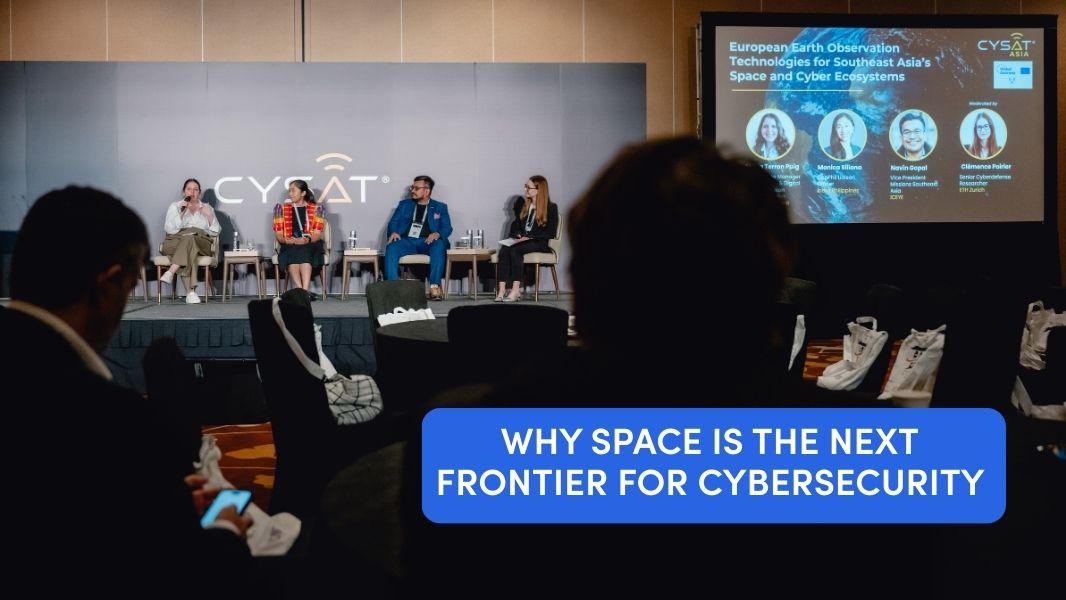
Amid growing threats to global space assets, over 400 experts and officials gathered at the inaugural CYSAT Asia 2026 to discuss challenges and opportunities in the new frontier of cybersecurity.
Cybersecurity is no longer just about ringfencing data and devices. With satellite networks now powering critical infrastructure from communications to transportation to energy grids, the battleground has expanded to space.
The global space cybersecurity market, valued at US$4.9 billion (S$6.2 billion) in 2025, is forecast to more than double to US$12.6 billion by 2035. The strong growth is driven by rising cyber threats to satellite systems, including widespread jamming and spoofing of GPS signals.
With some 15,000 active satellites currently in orbit – and over 500,000 expected by 2040 – the stakes for national security and the global economy are stratospheric.
The urgent need to secure space assets drew over 400 participants – including global experts, such as Mr Patrick Trinkler, CEO and Co-founder of CYSEC, government officials such as Brigadier Richard Alston, Deputy Director for Cyber and Electromagnetic Effects and Special Operations, and industry leaders, including Mr David Koh, Chief Executive from Cyber Security Agency of Singapore (CSA) from 25 Asian and European countries – to CYSAT Asia 2026 on 5 February.
Read: opening address at CYSAT Asia by Mr David Koh
The summit organised by SGInnovate and European cybersecurity leader CYSEC is the first Asian edition of the world’s leading event for space cybersecurity.

Group picture of organising teams from SGInnovate and CYSAT at the inaugural event.
Impetus for investment
While the space cybersecurity sector is seeing rapid growth, it has yet to emerge as a distinct investment category. This gap, however, is closing as new opportunities emerge.
One such opportunity concerns the security architecture of space tech. Satellite systems are designed long before they are launched. This means that the systems might be outdated by the time they are in space, leaving them vulnerable to emerging cyber threats.
This is particularly pertinent to governments, which have more stringent security requirements than commercial outfits, said Will Howerton, Managing Director at IQT, an American not-for-profit global investment platform focusing on tech. The public sector’s eagerness to solve the issue could see private companies benefitting from public investment, he said, adding that public-private partnerships are key.
In Singapore, SGInnovate has played a crucial role in boosting the sector through investment.
For example, it has backed SpeQtral, a Singapore-based startup providing space-based transmission and data security solutions. Other venture capitalists, who see little appeal in the space cybersecurity sector, have yet to follow suit, said Hsien-Hui Tong, SGInnovate’s Executive Director of Investments.
But SpeQtral has benefitted from grants from various government agencies, including the Cyber Security Agency of Singapore, the National Space Agency of Singapore, the Office for Space Technology & Industry, and the Infocomm Media Development Authority.
“The whole-of-Singapore approach needed to support such companies can be encapsulated by this example,” said Tong. “But while the government has a strong case for investing in the sector, there is still little interest from commercial companies,” he added, citing uncertain profitability as a reason.
Another problem is the lack of “full solutions” in the sector. “A lot of research, which is still at the university stage, focuses on a tiny slice of the problem,” Tong said.

Executive Director of Investments from SGInnovate, Hsien-Hui Tong, speaking alongside CEO of Innovaud, Patrick Barbey.
Creating a comprehensive ecosystem is critical, he said, but possible only with collaboration between public and private sectors across regions. “You need to establish a big enough market and impetus for people to want to invest in the sector,” he explained.
The cybersecurity and information technology sectors also need to work together to improve training and develop a talent pipeline.
Closing the talent gap
Talent development is crucial for industry liftoff.
“The biggest gap is probably not at the very early stage because there are support mechanisms and funding for early-stage projects. It’s about the stage that comes afterwards – talent is sorely needed,” said Patrick Barbey, CEO of Innovaud, a Swiss innovation and economic promotion agency.
For Juliana Lim, Executive Director, People, at SGInnovate, an “iceberg” model is the ideal approach to nurturing talent. Sitting at the tip of the iceberg is knowledge, and just beneath it are hands-on skills. The deepest and most important layer, she noted, is having the right mindset.

(L to R) Juliana Lim; Dr James Stanger, Chief Technology Evangelist, CompTIA; PakHo Chan, Founder, Principal Cybersecurity Advisor & Researcher, HephaX; Ethan Seow, CEO, Practical Cyber.
To enable this approach, clear career pathways are necessary to attract talent.
“Everybody struggles with what the next step is because tech is moving faster than ever before,” said James Stanger, Chief Technology Evangelist at the Computing Technology Industry Association (CompTIA), an American trade association that issues professional IT certifications. “Once you show them what the pathway is going to look like, they will need hands-on experience,” he added.
Watch: In conversation with Juliana Lim and Dr James Stanger
To this end, SGInnovate offers the SGInnovate Summation Programme for Talent, a three- to six-month specialised Deep Tech apprenticeship for undergraduate, master’s, and doctorate students, and PowerX, a 12-month Deep Tech traineeship for working professionals.
CompTIA also offers several training programmes on SGInnovate’s Deep Tech Central platform, including the CyberReady+ Bootcamp for mid-career professionals and fresh graduates, and SecAI+, a global certification focused on integrating AI into cybersecurity operations.
The niche nature of the sector could also put off potential talent. “Very often, people are terrified of entering this field because they think it is a big challenge, and they are terrified of failing,” said Ethan Seow, CEO of Practical Cyber, which offers cybersecurity courses for non-IT and business professionals.
Watch: How to succeed in a cybersecurity career
But being comfortable with failure is critical, he added. “Within the amount of time spent trying to perfect your first try, someone else could have failed many times and eventually gotten it before you.”
This idea of failing fast is something CompTIA emphasises in its training programmes, said Dr Stanger, who added that it equips space cybersecurity professionals with the resilience required to deal with complex threats.
Soon, space cybersecurity may no longer be a sector “in the shadows”, said Howerton.
Drawing parallels to the cybersecurity sector, which struggled to attract interest and talent at first but is now a high-priority field grappling with an acute workforce shortage, he said: “It is on a similar path of sensitising people to the fact that this is not a niche concern, but core to the healthy functioning of the space economy.” This shift, he added, will help attract more talent
Connect with experts in the Deep Tech ecosystem. Find out how you can get involved here.
Trending Posts
- How Leaders Can Turn AI Adoption into Lasting Transformation
- AI can fix your code, but it cannot fix bad architecture decisions
- Why some chip technologies make it to production - and others don't
- As space cybersecurity lifts off, talent and investment are key fuels
- The future of building inspections can’t stay manual. Meet the startup changing that.