

From satellites to startups, Singapore’s space sector is pushing new frontiers
Tue, 01/13/2026 - 12:00
With its deep tech capabilities and robust regulatory frameworks, Singapore is fast establishing itself as a major player in the global space sector.
In a booming global space economy, Singapore is steadily carving out its own orbit. Today, the country is home to 70 space companies, with the sector alone employing over 2,000 professionals across engineering, research and business roles.
Several homegrown companies are already gaining global traction. Transcelestial is preparing Singapore’s first inter-satellite laser communications mission, set for in-orbit tests in 2026. Meanwhile, SpeQtral has deployed a quantum-secure satellite that encrypts sensitive data, the first company outside of China to do so.
These breakthroughs are made possible by a supportive, stable regulatory environment and thriving innovation ecosystem. In 2025, the Singapore government pledged to invest an extra $60 million on top of its initial commitment of $150 million to boost the country’s space tech research, bringing the total amount of funding to over $200 million.
Bolstering the growing ecosystem is Singapore’s national space office, the Office for Space Technology & Industry, Singapore (OSTIn), which aims to grow Singapore’s space sector through strengthening research and development (R&D) capabilities and international partnerships.
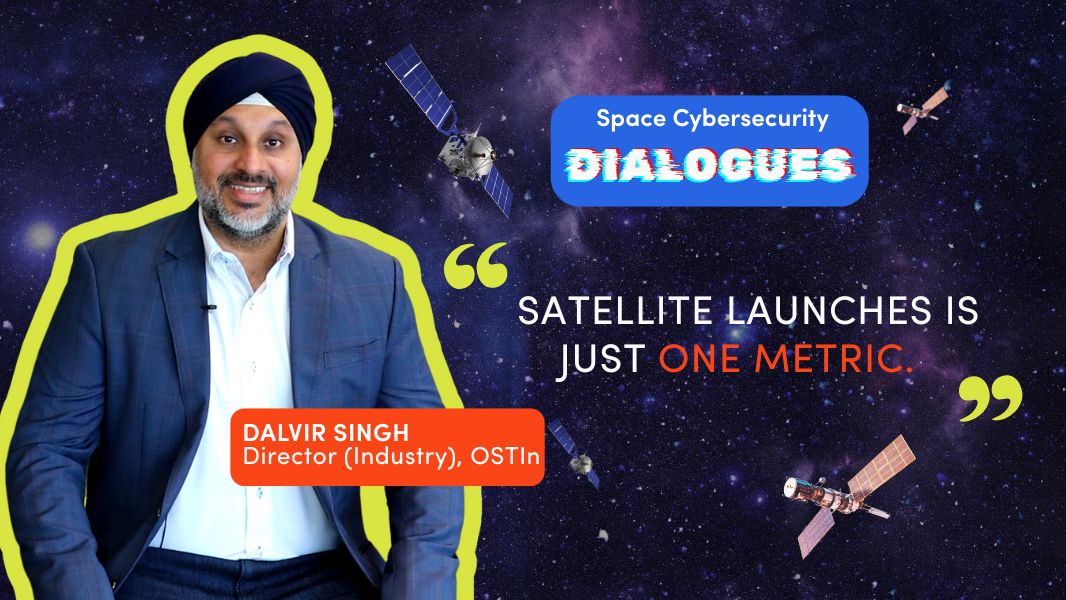
As CYSAT Asia 2026 – the region’s largest space cybersecurity conference – approaches, we speak to Dalvir Singh, Director (Industry) of supporting partners OSTIn, to hear his thoughts on why Singapore provides an ideal “soft landing” for space companies in Southeast Asia, and the connections he looks forward to building at the inaugural event.
1. How does OSTIn define growth for Singapore’s space sector?
Satellite launches are definitely one metric. To date, Singapore has launched more than 30 satellites — a mix of research and commercial missions for applications in Earth observation and satellite communications.
OSTIn also looks at the growth and participation of our companies in the global space economy. Singapore is home to over 70 local and foreign companies across the space value chain, with a focus on advanced manufacturing applications and emerging, niche R&D. These homegrown firms include ST Engineering Satellite Systems (SatSys), which provides innovative satellite solutions, and AddValue Technologies, whose Inter-satellite Data Relay System technology enables on-demand communication between ground operators and their satellites.
Lastly, we look at the impact the sector has on strategic terrestrial sectors and sustainability. In the maritime industry, for instance, space technology plays a key role in vessel tracking, coastal monitoring and illegal bunkering. In aviation, satellite innovation is crucial for mission-critical communications and air traffic management. Recently, the Civil Aviation Authority of Singapore, together with seven air navigation service providers, carried out a demonstration flight for trajectory-based operations. This is a new concept in air traffic management aimed at reducing flight time, costs and carbon emissions.
2. How important are partnerships in building a thriving space ecosystem?
Partnerships are the bedrock of space innovation — and that goes for Singapore as well. Singapore is an active participant of the United Nations Office for Outer Space Affairs’ initiatives, including the Committee on the Peaceful Uses of Outer Space. Here, we lend our voice and views to the development of space norms and laws to reinforce the importance of the sustainable and peaceful use of outer space.
OSTIn also works hard to ensure that Singapore has strong relationships with other countries. In February, we signed a letter of intent with the European Space Agency (ESA) to explore partnerships in business incubation and commercialisation. This led to Singaporean startups participating in ESA’s investor forum during the Paris Air Show in June.
OSTIn also launched its Earth Observation Initiative early this year. It brings together space technology companies and organisations that can benefit from the use of satellite technology. Already, the World Bank and Mekong River Commission Secretariat are working with Singapore's researchers and companies on areas like water quality management and crop yield prediction.
3. CYSAT Asia 2026 will happen during the week of the Space Summit 2026. How do you see it contributing to conversations around space during that period?
Where I think the two events work in synergy is that while the Space Summit focus on topics related to government, innovation and business, CYSAT Asia brings an added dimension by facilitating conversations related to risk and resilience. This is a timely topic that the community should talk about, especially with the proliferation of satellites and more countries pursuing space exploration.
It's timely that CYSAT has decided to host their first Asia Conference in Singapore - with its concentration of global leading industries and robust innovation ecosystem, Singapore has been a great place to innovate at the intersections of industries.
4. What kind of connections are you looking forward to making at CYSAT Asia 2026?
We aim to connect with global leading experts in the cybersecurity space and hear about how they are applying their views and knowledge to the space and satellite sector. It'll be interesting for us to understand what the latest threat vectors are and the key technologies and trends that are addressing those threats.
We are also keen to engage with innovative startups at the intersection of cybersecurity and space to learn more about their priorities and share what is going on in the region. If they are looking to grow in Southeast Asia and beyond, we hope to be able to work with them to see how they can achieve a soft landing in Singapore.
CYSAT Asia, organised by SGInnovate and European cybersecurity company CYSEC, runs at the Sands Expo & Convention Centre on 5 February 2026. Find out more here.
Trending Posts
- How Leaders Can Turn AI Adoption into Lasting Transformation
- AI can fix your code, but it cannot fix bad architecture decisions
- Why some chip technologies make it to production - and others don't
- As space cybersecurity lifts off, talent and investment are key fuels
- The future of building inspections can’t stay manual. Meet the startup changing that.