

Overview
ITIL® Foundation (Version 5) introduces candidates to the key concepts of digital product and service management and establishes a common language for effective practice across organizations. It provides an overview of the ITIL framework, including its guiding principles, core models and fundamental concepts and explains how these elements are used to create, deliver and continually improve products and services.
ITIL Foundation (Version 5) enables candidates to understand how value is co-created through the effective management of products and services, and how organizations apply ITIL guidance to improve performance, collaboration and outcomes. It also explains how the ITIL framework has evolved to support modern technologies, data-driven decision-making, automation, artificial intelligence and contemporary ways of working, while remaining adaptable to different organizational contexts and levels of maturity.
Course Description & Learning Outcomes
Course Outline
ITIL Terms and Definitions
Product and Service: Defining digital product and service management, product, service, digital products/services, continual improvement, the Product and Service Lifecycle, goods, utility, warranty, user experience, and sustainability.
Experience, Strategy and Transformation: Defining experience, trust, UX, CX, experience level agreements, human-centred design, strategy, business/digital strategy, vision, mission, VUCA, leadership, change, and business as usual (BAU).
Service Offerings: Defining and explaining service offerings, interactions, service actions, transfer of goods, and access to resources.
Value and Value Co-creation: Defining value, cost, risk, output, and outcome. Explaining the difference between output and outcome and how feedback, utility, and sustainability contribute to co-creation.
Service Relationships: Defining organizations, service providers, consumers, and vendors. Understanding the differences between these roles and different relationship types (basic, cooperative, collaborative).
Service Management Roles and Concepts: Defining sponsor, customer, user roles, service quality, service level, and Service Level Agreements (SLA).
Four Dimensions of Product and Service Management
The Four Dimensions: Listing the dimensions (organizations and people, partners and suppliers, information and technology, value streams and processes).
Holistic Approach and External Factors: Understanding the importance of each dimension, the necessity of a holistic approach, and external PESTLE factors (Political, Economical, Social, Technological, Legal, Environmental).
ITIL Product and Service Lifecycle
Lifecycle Activities: Listing and understanding the lifecycle activities: discover, design, acquire, build, transition, operate, deliver, and support.
Nature of Activities: Understanding that lifecycle activities are non-linear, non-sequential, and iterative.
Purpose of Activities: Knowing the specific purpose of each individual activity within the lifecycle (e.g., the purpose of ‘discover’, ‘design’, ‘support’, etc.).
ITIL Value System
Value System Components: Knowing the components (Guiding principles, Governance, Value chain, Management practices, Continual improvement) and explaining the system’s purpose.
Guiding Principles: Listing the principles and understanding how to use each one (e.g., Focus on value, Start where you are, Think and work holistically).
Governance: Defining governance and explaining its enabling nature and activities.
Value Chain: Defining value chain, product specifications, incident, release, and continuous integration/deployment. Understanding success metrics and how the operating model is supported by value chain activities.
Management Practices: Defining management practices, knowing the groups (general vs. product/service), and understanding the role and benefits of ITIL Practice Guides.
Continual Improvement Model: Listing and understanding the steps of the ITIL Continual Improvement Model.
Value Stream Identification, Mapping, and Management
Value Stream Concepts: Defining value streams (core and enabling), value stream mapping, and complexity thinking.
Application and Mapping: Understanding how to optimize workflows for complexity and the relationship between value stream mapping and management.
ITIL and Artificial Intelligence (AI)
AI Fundamentals: Defining AI, AI maturity, GenAI, and Agentic AI.
AI in the Lifecycle: Understanding how AI assists in product development, process automation, and how it is leveraged throughout the ITIL value chain.
AI Governance: Defining AI governance and understanding the ITIL AI Capability Model.
ITIL and Other Frameworks
ITIL and DevOps: Understanding how ITIL collaborates with and complements DevOps practices in the product development lifecycle.
ITIL and PRINCE2: Understanding the importance of project management and how ITIL and PRINCE2 work together.
For more information, please click here
Recommended Prerequisites
At least 1 year of working experience in the IT industry.
English proficiency equivalent to the Employability Skills WSQ Workplace Literacy (WPL) Level 6 (reading, writing, speaking, and listening).
Schedule
End Date: 08 Apr 2026, Wednesday
Duration: 3 Days, 22.5 hours Timing: 9am - 5.30pm Delivery Modes: Facilitated Classroom / Virtual Training
Location: OnlinePricing
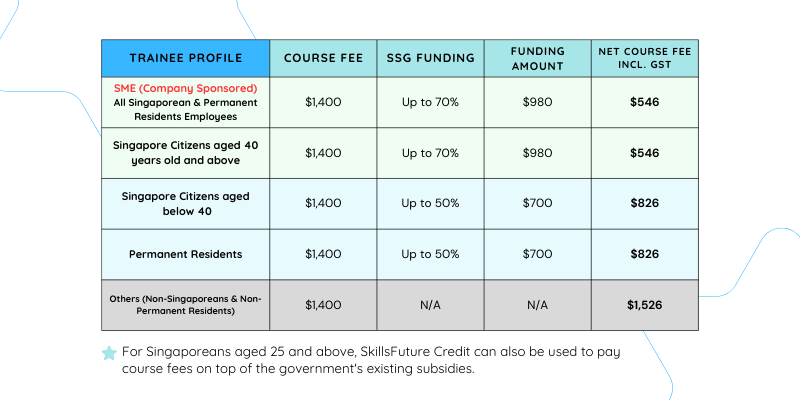
Course fees: If you meet the eligibility criteria, course fees can be subsidised by up to 70%. Moreover, SkillsFuture Credit can be applied to cover course fees in addition to existing government subsidies.
Skills Covered
PROFICIENCY LEVEL GUIDE
Beginner: Introduce the subject matter without the need to have any prerequisites.
Proficient: Requires learners to have prior knowledge of the subject.
Expert: Involves advanced and more complex understanding of the subject.
- Information Systems (Proficiency level: Beginner)