

Overview
The ITIL® Foundation Bridge (Version 5) is a fast‑track, 1‑day course designed for professionals who already hold ITIL® 4 Foundation and want to upgrade to ITIL Foundation (Version 5) by focusing only on what is new and changed in the latest framework. Instead of repeating the full Foundation curriculum, it concentrates on the deltas in digital product and service management, the evolved Service Value System (SVS), updated guiding principles, and enhanced governance and AI‑related guidance.
By the end of the course, participants will understand how ITIL® Version 5 builds on ITIL® 4, how the updated guidance supports modern digital, data‑driven and AI‑enabled environments, and how to apply these changes in their own organizations.
Course Description & Learning Outcomes
Module 1: Key ITIL terms and definitions
Product and Service Management
Digital Product and Service Management
Product, Service as a Key Concept of Digital Product and Service Management
Digital Product, Digital Service as a Key Concept of Digital Product and Service Management
ITIL Product and Service Lifecycle as a Key Concept of Digital Product and Service Management
Service Offerings
Service Offering and Service Interactions
Service Offering and Service Interactions
Service Actions, Transfer of Goods, Access to Resources
Value Co-Creation
Value and Value Co-Creation
Cost and Risk
Output and Outcome
Understand the Difference Between Output and Outcome
How Value Contributes to Value Co-Creation?
How Outcomes, Costs, Risks Contribute to Value Co-Creation?
Module 2 : Service Relationships
Define organization, service provider, service consumer, and digital product vendor as key concepts of service relationships
Define basic, cooperative, and collaborative (partnership) service relationship as key concepts of service relationships
Define the service journey as a key concept of service relationships
Define sponsor, customer, and user roles as key concepts of service relationships
Define service quality and service level as key concepts of service relationships
Define Service Level Agreement (SLA) as a key concept of service relationships
Understand the role of service provider, service consumer, and digital product vendor in service relationships
Understand the difference between basic, cooperative, and collaborative (partnership) service relationships
Explain utility, warranty, user experience, and sustainability as key concepts of service relationships
Module 3 : The ITIL Value System
Understand the components of the ITIL Value System and their role in an organization, including guiding principles, governance, the value chain, management practices, and continual improvement
Explain the ITIL Value System and its purpose in enabling value co-creation through products and services.
Module 4 : Governance
Define governance and its role in directing and controlling an organization
Explain the enabling nature of governance and the key activities through which governance supports value co-creation.
Module 5 : ITIL Guiding Principles
Explain how the ITIL Guiding Principles should be applied in different contexts
Describe how the ITIL Guiding Principles interact to support effective decision-making and continual improvement
Explain how feedback contributes to value co-creation.
Module 6 : Value Chan and ITIL Management Practices
Identify the purpose of each ITIL Product and Service Lifecycle management activity within the value chain
Recall key terms and definitions related to value chain activities
Explain how value chain activities are supported by management practices to enable value creation
Understand the role of management practices within the ITIL Value System
Explain the structure and benefits of the Official ITIL Practice Guides.
Module 7 : Value Streams: Mapping and Management
Know the purpose and key concepts of value stream mapping and management
Understand the relationship between value stream mapping and value stream management.
Module 8 : Continual Improvement
Describe continual improvement within the ITIL Value System and its role in organizations
Understand the steps of the ITIL Continual Improvement Model.
Module 9 : The ITIL Four Dimensions of Product and Service Management
Explain the ITIL Four Dimensions of Product and Service Management and their importance in a holistic approach
Understand how AI can assist in the product and service lifecycle
Understand the ITIL AI Capability Model.
Module 10 : ITIL and other Frameworks Integration
Understand how ITIL and DevOps complement each other across the product and service lifecycle
Recognize how ITIL practices can effectively collaborate with DevOps ways of working
Understand why project management is important when applying ITIL practices
Understand why project management is important when applying ITIL practices
Recommended Prerequisites
At least 1 year of working experience in the IT industry.
English proficiency equivalent to the Employability Skills WSQ Workplace Literacy (WPL) Level 6 (reading, writing, speaking, and listening).
Schedule
Date: 25 May 2026, Monday
Time: 9:00 AM - 5:00 PM (GMT +8:00) Kuala Lumpur, Singapore
Location: 3 Kallang Jct, #04-02 Vanguard Campus, Singapore 339265, 339265
Pricing
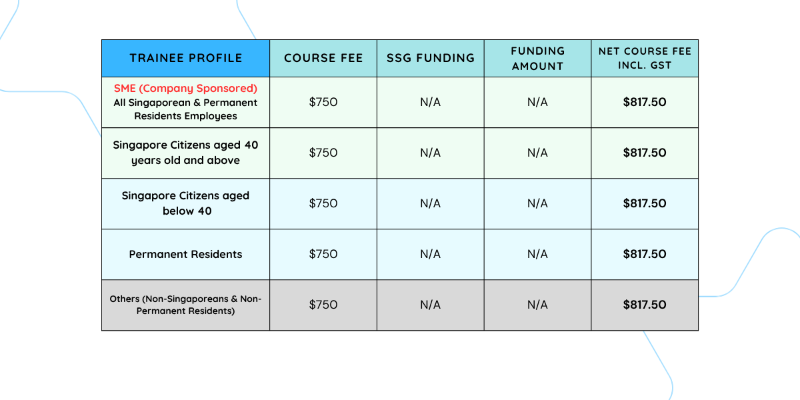
Course fees: If you meet the eligibility criteria, course fees can be subsidised by up to 70%. Moreover, SkillsFuture Credit can be applied to cover course fees in addition to existing government subsidies.
Skills Covered
PROFICIENCY LEVEL GUIDE
Beginner: Introduce the subject matter without the need to have any prerequisites.
Proficient: Requires learners to have prior knowledge of the subject.
Expert: Involves advanced and more complex understanding of the subject.
- Information Systems (Proficiency level: Beginner)