

How to Future-Proof a Career in Deep Tech? Start here.
Mon, 12/22/2025 - 12:00
As Deep Tech reshapes industries at lightning speed, professionals need more than technical expertise. They must connect disciplines, lead teams, and adapt to constant change. SGInnovate has partnered with Emeritus to equip talent with the skills needed to thrive in AI, Cybersecurity, Biotech, and beyond.
Combining SGInnovate’s understanding of the local Deep Tech ecosystem with Emeritus’ expertise in world-class learning design, curated, practical courses and leadership programs, participants will gain industry-aligned knowledge, earn globally recognised certifications, and build the multi-disciplinary skillsets increasingly demanded by Deep Tech startups.
Note: A 20% discount for all Emeritus' courses is available for learners who enrol via SGInnovate’s Deep Tech Central platform or the dedicated microsite.
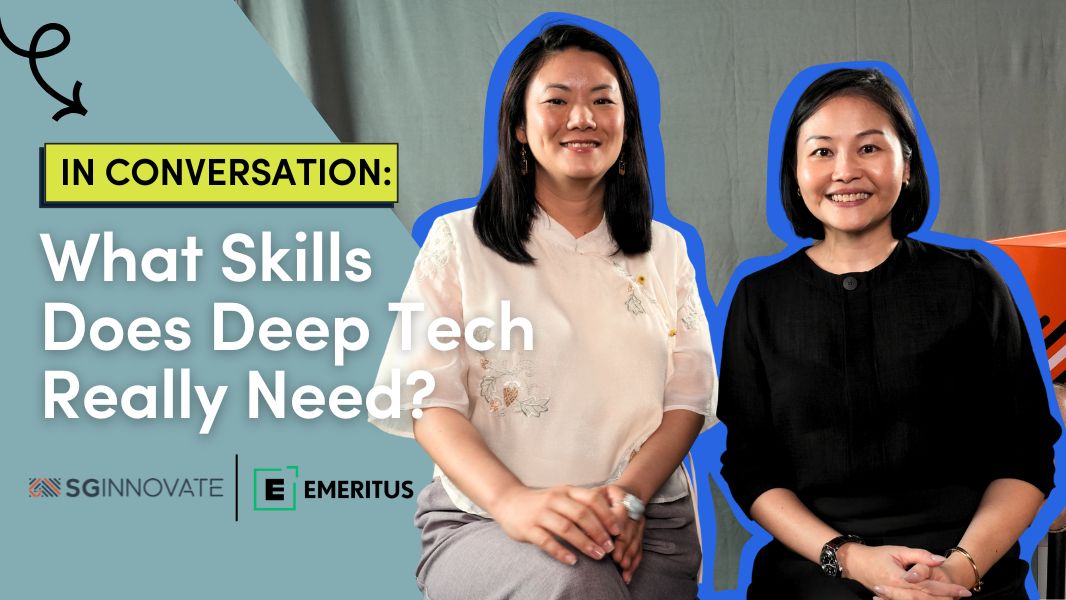
Jae Annie Tay, Director of People at SGInnovate, and Jeszlene Zhou, Country Lead, Greater China at Emeritus, shared insights on the current skills gaps in Deep Tech and highlighted what professionals need to consider to upskill, the soft skills that employers look out for and how to respond to emerging technology such as advancements in AI and quantum.
1. For those unfamiliar, who are SGInnovate and Emeritus? What roles do you play in the Deep Tech ecosystem, and what brought this collaboration together?
Jeszlene (Emeritus): At Emeritus, we bring in a full suite of learning opportunities for Deep Tech talent, whether it’s for upskilling through online initiatives, tech leadership development for emerging C-level tech leaders and microlearning platforms for learning in the flow of work.
We saw that SGInnovate has this great community of Deep Tech talent from all levels and industries who are constantly looking to grow, and found this partnership to be a natural decision.
Jae (SGInnovate): At SGInnovate, we back and build Deep Tech startups by helping researchers and engineers bring impactful innovations from lab to market. A big part of that involves talent - creating multiple entry points for people to learn, upskill, and start meaningful careers in Deep Tech.
Our “Let’s Tech It” learning series (Tech Talks, Tech Bytes, Tech Walks) and talent programmes like Summation, PowerX, and the Helix Immersion Programme are all designed to help people learn in ways that fit their stage of career.
Together, we are bringing SGInnovate’s ecosystem expertise and Emeritus’ strengths in learning design to develop a more relevant, future-ready Deep Tech workforce. While we work with a range of trusted learning partners across the ecosystem, this collaboration with Emeritus is further strengthened by their global expert network - including subject matter experts such as Dr. Matilde D'Amelio (Founder of Sophia Training & Consultancy - an SGInnovate learning partner) who serves as a programme leader for Emeritus’ courses.
2. Why is talent development such a big focus for Deep Tech right now?
Jae (SGInnovate): Deep Tech is evolving at incredible speed, and startups need people who can bridge science, engineering, and business. That’s why upskilling and leadership development aren’t optional – they are what keep the ecosystem competitive.
The talent challenge is intensifying:
- 83% of Singapore employers struggle to hire skilled talent (ManpowerGroup 2025).
- The hardest roles to fill are in IT/Data (32%) and Engineering (27%).
- Globally, 59% of tech professionals plan to switch jobs within a year (Hays), which intensifies competition.
- Tech roles now command a 64% higher median salary than the national median (IMDA), showing how scarce these skills are.
- The cybersecurity workforce stands at 5.5M, but 10.2M are needed (ISC2 2024 Cybersecurity Workforce Study).
- 44% of workers’ core skills will be disrupted by 2027 (Future of Jobs Report 2023).
Beyond technical depth, founders urgently need cross-functional leaders who can connect technology, strategy, and execution.
This is why SGInnovate and Emeritus are doubling down on continuous learning - to help talent keep pace with the demands of Deep Tech’s next chapter.
Jeszlene (Emeritus): Industries everywhere are shifting - not only because of AI, but also due to geopolitics, demographic changes, climate challenges, and cyber risks. This forces a rethink of how people build skills.
Where T-shaped talent used to be enough, today’s world needs M-, V-, and X-shaped talent who can work across specialisations, bridge disciplines, and lead diverse teams.
The only way to stay competitive is constant learning, unlearning, and relearning.
3. What skills or gaps are Deep Tech founders talking about the most?
Jae (SGInnovate): Founders tell us their biggest challenge is finding people who have both deep technical knowledge and the ability to execute in the real world. The most in-demand talent can “speak science” and “speak business.”
The gaps show up in three key areas:
1. Core Domain Expertise — Strong foundations in Life Sciences, Materials, Engineering, Robotics, or Computer Science remain essential.
2. Multi-Disciplinary Skills — Hybrid capabilities are growing fast, such as:
- AI + Engineering
- Life Sciences + Data Science
- Hardware + Software Integration
This reflects the convergence happening across Deep Tech sectors.
3. Critical Core Skills — Startups need people with:
- Problem-solving and systems thinking
- Strong communication and stakeholder engagement
- Agility and adaptability
- Curiosity and an experimentation mindset
These are what help talent thrive in high-uncertainty, innovation-driven environments.
Jeszlene (Emeritus): AI is shifting so quickly that talent must constantly keep up with new launches, tools, and frameworks every other day or week. Beyond the technical know-how behind machine learning, deep learning, supervised learning or Reinforcement Learning from Human Feedback (RHLF), we need talent who can select the best tools and keep up with the latest developments.
There’s also growing demand for quantum computing skills. As industries prepare for the impact of quantum on cybersecurity and resilience, talent who understand quantum risks and strategies will be increasingly sought after. We see that particularly in the finance and telco industries.
4. What will participants gain from the SGInnovate x Emeritus collaboration? What activities are in the pipeline?
Jae (SGInnovate): Participants can expect practical, job-ready learning - skills they can apply immediately in areas like AI, Cybersecurity, and Healthcare Technology.
They’ll gain:
- Practical, industry-aligned capabilities
- Certifications from top global institutions
- Clearer pathways to contribute to Deep Tech innovation
- Leadership development opportunities for technical leads and aspiring CTOs
We’ve launched a joint learning microsite with curated courses tailored to real startup needs. In the months ahead, we’ll also run Tech Talks and workshops that bring together online learning with hands-on, real-world insights.
The goal is simple: help talent stay relevant, confident, and ahead in Deep Tech.
Jeszlene (Emeritus): Through our partnerships with top universities like Harvard, MIT, Columbia, and Cambridge, we bring global perspectives and the latest academic insights into our programmes.
With our dedicated SGInnovate portal, Deep Tech Central members can easily explore curated courses and receive personalised support along their learning journey.
5. What does success look like for this partnership?
Jae (SGInnovate): Success is measured by impact, not just enrolments. It means:
- Talent at every stage feeling that Deep Tech is accessible and supported
- Engineers, scientists, and founders gaining the skills to build globally competitive companies
- A stronger national talent base that anchors emerging industries and accelerates research translation
If more people feel empowered to join, build, and lead Deep Tech ventures, and in doing so strengthen Singapore’s innovation ecosystem, we’ve achieved what we set out to do.
Jeszlene (Emeritus): Success is when learners walk away with meaningful insights they can apply at work and enhance their career.
Our hope is for learners to gain their own unique takeaways from the university professors, their global peers, or practical assignments - while still having the flexibility to learn at their own pace and in their own style.
6. What advice do you have for talent to thrive in Deep Tech?
Jeszlene (Emeritus): Curiosity is key. A natural drive to learn helps you stay ahead of industry shifts and continuously build your skillsets.
Jae (SGInnovate): Stay curious. Deep Tech moves fast - learning needs to be a lifelong habit.
Think across disciplines. The most valuable talent understands not just the “what,” but the “why” and “so what.”
Learn by doing. Engage with the community, walk through labs, and work with startups. Nothing replaces real-world exposure.
Embrace uncertainty. Deep Tech is bold, experimental, and often messy - the best talent stays resilient and adaptable.
Think globally. Deep Tech is borderless; global awareness gives you an edge from day one.
At the end of the day: build yourself, so you can build the future.
Trending Posts
- How Leaders Can Turn AI Adoption into Lasting Transformation
- AI can fix your code, but it cannot fix bad architecture decisions
- Why some chip technologies make it to production - and others don't
- As space cybersecurity lifts off, talent and investment are key fuels
- The future of building inspections can’t stay manual. Meet the startup changing that.