

Keeping satellites safe: How CYSAT Asia 2026 is tackling space cybersecurity
Mon, 12/08/2025 - 12:00
Cyberattacks on satellites can be highly disruptive, and require regulators, industry leaders, and academics to work together to prevent such incidents.
Screens went blank, phones had no dial tones, and the internet could not be accessed. The satellite network belonging to Viasat, a communications firm that enabled internet access for tens of thousands of people across Europe, had been hit by a massive cyberattack.
The incident in February 2022, was one of the most disruptive attacks on the space industry that has been a target for years. Between 1977 and 2019, there were almost 80 known attacks against satellites.
More recently, these incidents have gained momentum. There were 117 cyberattacks against the space industry between January and August 2025 — a 118 per cent increase over the same period in 2024. This trend is only going to grow with technological advances and an increasing reliance on space infrastructure, which is quickly emerging as a key backbone of the modern economy.
This is where CYSAT Asia 2026 comes in. The event, which will take place on 5 February 2026, is making its Asia debut in Singapore. Co-organised by SGInnovate and Europe-based cybersecurity firm CYSEC, it will gather attendees from all over the world representing government, academia, and industry to discuss emerging challenges in the arena of space cybersecurity.
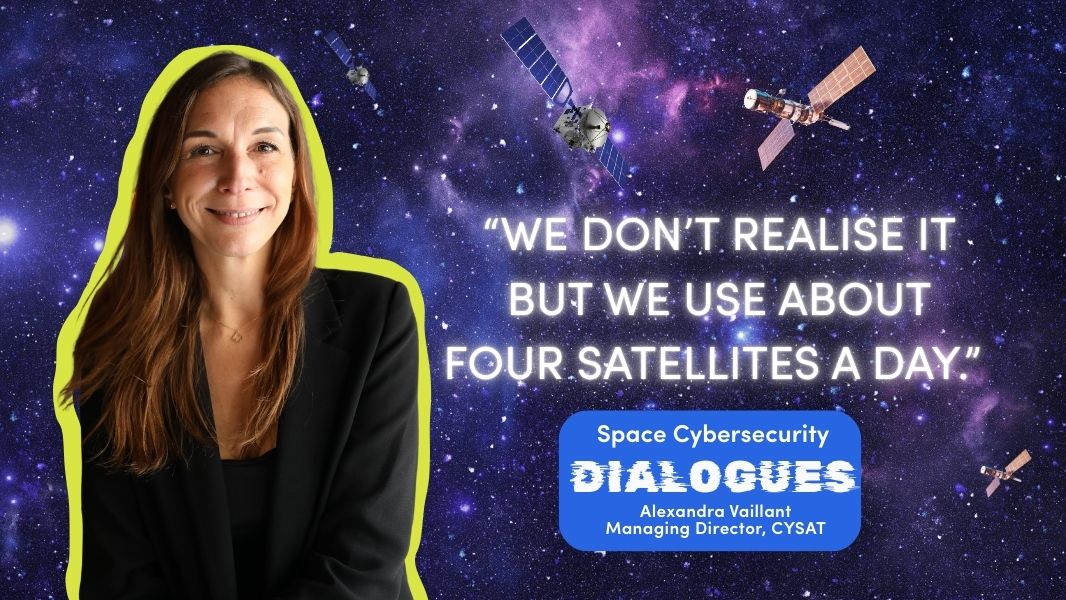
Why does the safety of satellites matter, and which industries need to pay attention? We speak to Alexandra Vaillant, Managing Director of CYSAT, to find out.
1. Why is space cybersecurity at risk today, and what are CYSAT’s goals?
Satellites are part of our daily lives. We use them to check the GPS, the weather, to communicate, and of course, for defense. But they are susceptible to jamming and spoofing, which is when false signals are used to interfere with genuine signals, or even direct attacks. With the 2022 Viasat attack, we saw how (satellites) have a big impact on global infrastructure. They are such big targets now, and we need to make sure that they are secure.
CYSAT’s goal is to foster synergy among industry leaders, researchers, startups, national agencies, and many others. We want to make sure that everyone is openly discussing cybersecurity challenges in the space industry. With CYSAT Asia, we also want to extend collaboration between communities in Europe and the Asia-Pacific, so that everyone can collaborate beyond borders.
2. Which industries need to be engaged early, and why?
There are many industries that can be impacted by vulnerabilities in the space sector. Let’s think about aviation. Planes depend on satellites for navigation and connectivity. It’s the same for the maritime industry. Ships use satellites for cargo tracking, and if you mess with those signals, it can disrupt global trade routes and open doors to piracy.
Companies in these industries often rely on a network provider, which relies on a satellite operator. So, they may see cybersecurity as “not their problem”. That’s the main issue here — they don’t really think about it. It’s only when there is an incident that they think cybersecurity is important. We want these industries to be part of the conversation at CYSAT Asia.
3. What kind of talent will be needed in the space cybersecurity sector?
We need a mix of talents. In the space industry, you have cryptographers, ethical hackers, aerospace engineers, flight software engineers, even cloud architects — because satellites can be operated from the cloud, and their data sent to the cloud.
Many engineers are involved in this field, but when you put a space engineer and cyber engineer together, for example, they don’t speak the same language. One of the main ambitions of CYSAT is to make sure that these people can work together, understand each other, and collaborate, rather than be in silos.
4. What makes Singapore a good place to host CYSAT Asia?
Singapore is the perfect location to bring Asians and Europeans together to discuss cybersecurity. There are many industries here like aviation and maritime, which makes it a good place to “mix” industries. There’s also a lot of talk about 6G networks here.
At the same time, Singapore takes cybersecurity very seriously. The Cyber Security Agency of Singapore (CSA), which was established in 2015, does an amazing job promoting innovation within the cybersecurity ecosystem. In 2019, CSA and industry partners launched the operational technology (OT) Cybersecurity Masterplan to bolster defences against attacks on critical infrastructure services in Singapore, in areas like energy, water, and transport. This plan was updated in 2024 in the face of technological shifts, evolving geopolitical environments, and a maturing OT system.
5. What can participants expect from CYSAT Asia?
CYSAT is not an event, it’s more like a community. We have a tagline: learn, discover, and network. There will be three stages at the event:
- A master stage, where you can learn by listening to business keynote speeches, roundtables, and panel discussions between industry leaders
- A technical stage, or startup stage, where companies will showcase their latest products in a storytelling rather than commercial way
- Four networking sessions planned around lunch breaks, coffee breaks, and drinks, to make sure that people can meet in a friendly atmosphere
Participants can also learn through CYSAT Academy sessions, which we’ve been organising for four years. During CYSAT Asia, there will be two three-hour sessions, one run by Thales and the other by HelvetiSpace. You will learn how to hack a satellite, or look for vulnerabilities in satellites. At the end of the session, you will get a certification saying that you attended a training session on space cybersecurity.
I’m very excited because this is the first time we are organising CYSAT in Asia. It was in Paris for five years. When we first launched CYSAT back in 2021, it was very small — only 150 people on site. Today in Paris, we have around 800 people attending from all over the world, from Canada and the US to Europe. What we aim to do with SGInnovate is create that community in Singapore with people from Australia, Europe, the Philippines, Malaysia, Taiwan, and more.
CYSAT Asia, organised by SGInnovate and European cybersecurity company CYSEC, runs at the Sands Expo & Convention Centre on 5 February 2026. Find out more here.
Trending Posts
- How Leaders Can Turn AI Adoption into Lasting Transformation
- AI can fix your code, but it cannot fix bad architecture decisions
- Why some chip technologies make it to production - and others don't
- As space cybersecurity lifts off, talent and investment are key fuels
- The future of building inspections can’t stay manual. Meet the startup changing that.