

The future of fusion energy: What will it take to bring the power of the stars to earth?
Mon, 12/08/2025 - 12:00
Singapore’s first fusion energy event, FusionX:Singapore, was held on 30 October 2025 on the sidelines of the Singapore Week of Innovation and Technology (SWITCH). Organised by global fusion ecosystem-builder FusionX and SGInnovate, the event convened international and local fusion experts from critical enabling sectors such as investments, R&D, partnerships and education. Discussions focused on overcoming barriers in regulation, supply chains and infrastructure, and on Singapore’s role in building the talent pipeline needed to capture this emerging market.
Fusion energy powers the sun, and one day, it could power earth, too.
Per kilogramme of fuel, fusion generates nearly four million times more energy compared to coal and oil, making it a potentially limitless source of power that could fuel the planet in the age of artificial intelligence and beyond.

CEO of SGInnovate, Dr Lim Jui, during his opening address.
But what will it take to engineer and commercialise fusion technology, and turn it from a dream into reality? Strengthening scientific understanding of fusion is only one part of the equation. Beyond that, the wider ecosystem of stakeholders — including startups, corporations, regulators, investors and more — must work together to unlock capital and build the partnerships and pipelines that will propel fusion into the future.
*Note: Discussions were held under Chatham House rules, which means speakers cannot be named.
Science will spur investment
Fusion technology has been around for years. But the industry is still considered nascent, given that it has yet to achieve sustained net positive energy generation.
In turn, this has caused some investors to hold back. “It’s always been a case where the science (of fusion) had not yet reached a stage where we felt that as an investor, we could pull the trigger,” said one panellist at FusionX:Singapore.

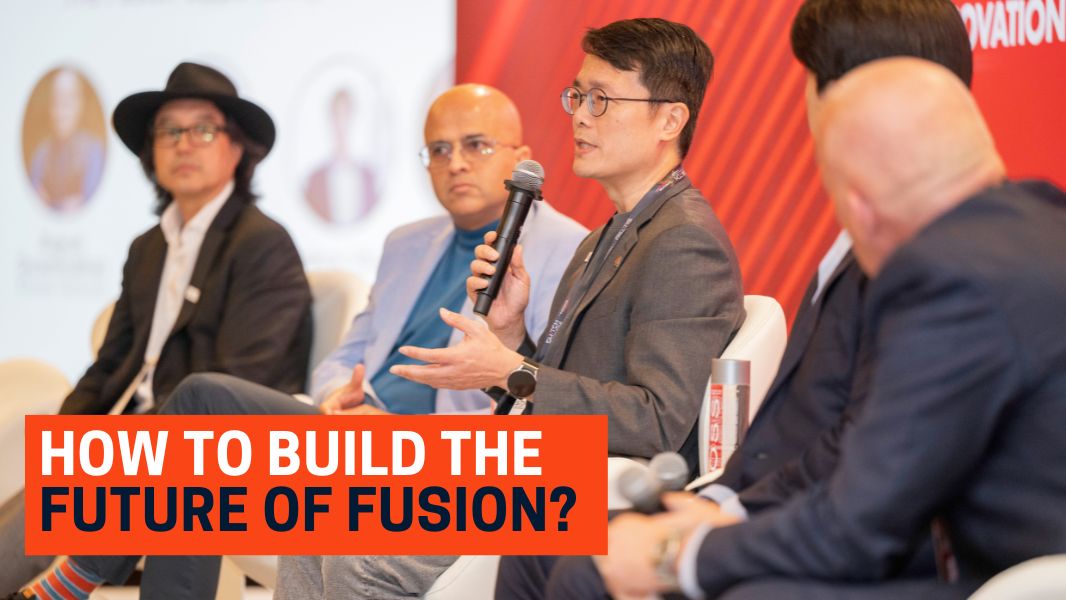
Speakers on the investment panel which covered topics such as infrastructure opportunities and Singapore’s market potential. (L to R: Scott Hsu, Head of Fusion, Lowercarbon Capital; Rajesh Swaminathan, Partner, Khosla Ventures; Hsien-Hui Tong, Executive Director, Investments, SGInnovate; Andrew Wong, Director, TRIREC; Stuart Allen, CEO & Co-Founder, FusionX)
But strides have been made in recent years. Speakers acknowledged that fusion technology is becoming more versatile and able to be commercialised across sectors, helping to de-risk investments and avoid binary outcomes — when technology fails and the entire investment has to be written off.
Accordingly, companies like SGInnovate have put some skin in the game, with investments in Focused Energy, a global deep-tech firm working on commercialising laser fusion, a method in which lasers are used to heat and compress fuel pellets to initiate a fusion reaction.
Still, panellists agreed that more needs to happen to catalyse funding. While scientific breakthroughs such as a historic experiment in 2022 at the National Ignition Facility in California saw a laser-powered fusion reaction successfully produce more energy than it consumed, the science is only about 80 per cent complete, said one speaker.
“The science and the enabling technologies that allow you to create fusion conditions in the laboratory…that’s the hardest part.”
Enabling technologies include high temperature superconductors and other advanced materials. Achieving these scientific milestones will unlock capital and help to make fusion power plants not just viable, but economically attractive, panellists said.
High potential for payoff
As fusion technology matures, so must the wider ecosystem. In particular, crossover technologies from other up-and-coming sectors like quantum can help to spur fusion forward.
“Everyone is converging on certain technologies that are going to move the innovation ecosystem forward,” said a panellist, adding that building a cross-sector supply chain can help to speed up the path to commercialisation — whether fusion or another technology is first to cross the finish line.
The rise of electric vehicles in recent years shows that commercialisation is possible, noted another panellist. Twenty years ago, the market for electric vehicles was much less robust compared to now due to limitations in battery development.

Thomas Forner, Founder & President, Focused Energy on a panel with other fusion innovators.
But with support from governments, electric vehicles are today a thriving commercial industry. “(Lasers) are built like satellites, but we have to build them like cars,” quipped the panellist.
Successful commercialisation of fusion technology will have payoffs beyond the energy sector, agreed panellists. Fusion reactions can help to produce medical isotopes such as tritium, which has a variety of clinical uses including diagnosing cancer and AIDS.
Fusion neutrons, which are released during the fusion of atomic nuclei, also have applications in the defense and space industry. They are used in radiation hardening testing, which involves designing electronics to withstand high radiation.

Panel discussing the applications of fusion energy. (L to R: Talmon Firestone, CEO, Astral Systems; Masami Hayashi, Executive Officer (Global Strategy Director), Clean Plane; Tomoaki Imai, COO, MiRESSO; Xavier Garbet, Professor / Research Director, CEA and NTU; DooWhan Choi, CEO, Enable Fusion; Rob Buckingham, Executive Director at UK Atomic Energy Authority)
“There are a lot of ways that fusion neutrons can be used to make a meaningful impact in adjacent industries,” a panellist said.
Building a talent pipeline
While there is still some way to go, the future of fusion is bright. As the industry grows, so does its appetite for talent.
Even though the United Kingdom is looking to train between 2,000 to 3,000 more people in the fusion space by 2030, there isn’t much of a fusion talent ecosystem in Singapore, said one speaker. Attracting quality talent will be key in unleashing fusion’s potential in the Lion City.
“What I find works is to tell people that you have a chance to be part of the next generation of energy,” said one panellist. “You give people a chance to make a difference.”

Panellists discussing what it will take to build the fusion workforce of the future. (L to R: Matthew Chew, Nuclear Competency & Strategy Lead, HY M&E Engineering Consultancy; Alexander Gunn, Senior Scientist, Alpha Ring; Valerian Hall-Chen, Head, Plasma Physics and Diagnostics, A*STAR; Michael Short, Professor, Department of Nuclear Science and Engineering, MIT; Juliana Lim, Executive Director, People, SGInnovate)
Such opportunities are not limited to younger folk who have yet to choose their career paths. As one panellist put it, fusion is for “people who like to work on difficult problems”.
Even mid-career or senior members of the workforce can pivot from their fields to fusion, especially if their existing jobs train them to be both a domain expert and a system thinker.
Aerospace engineers are a particularly good fit for fusion, said one speaker, noting that they have to understand not just the components they design, but also how that component fits into and affects the wider product they are engineering.
There are plenty of online resources available for those interested in learning about fusion — including a free YouTube series by Michael Short, a Professor at the Department of Nuclear Science and Engineering at the Massachusetts Institute of Technology.
One panellist noted that it was especially important to “keep the spark going” in young people and help them nurture their passion and purpose.
“Get the right people to be the tip of the spear…You need that first group to be there so that the rest can follow.”
Find out more about SGInnovate’s upcoming networking and community events here.
Trending Posts
- How Leaders Can Turn AI Adoption into Lasting Transformation
- AI can fix your code, but it cannot fix bad architecture decisions
- Why some chip technologies make it to production - and others don't
- As space cybersecurity lifts off, talent and investment are key fuels
- The future of building inspections can’t stay manual. Meet the startup changing that.