


Overview
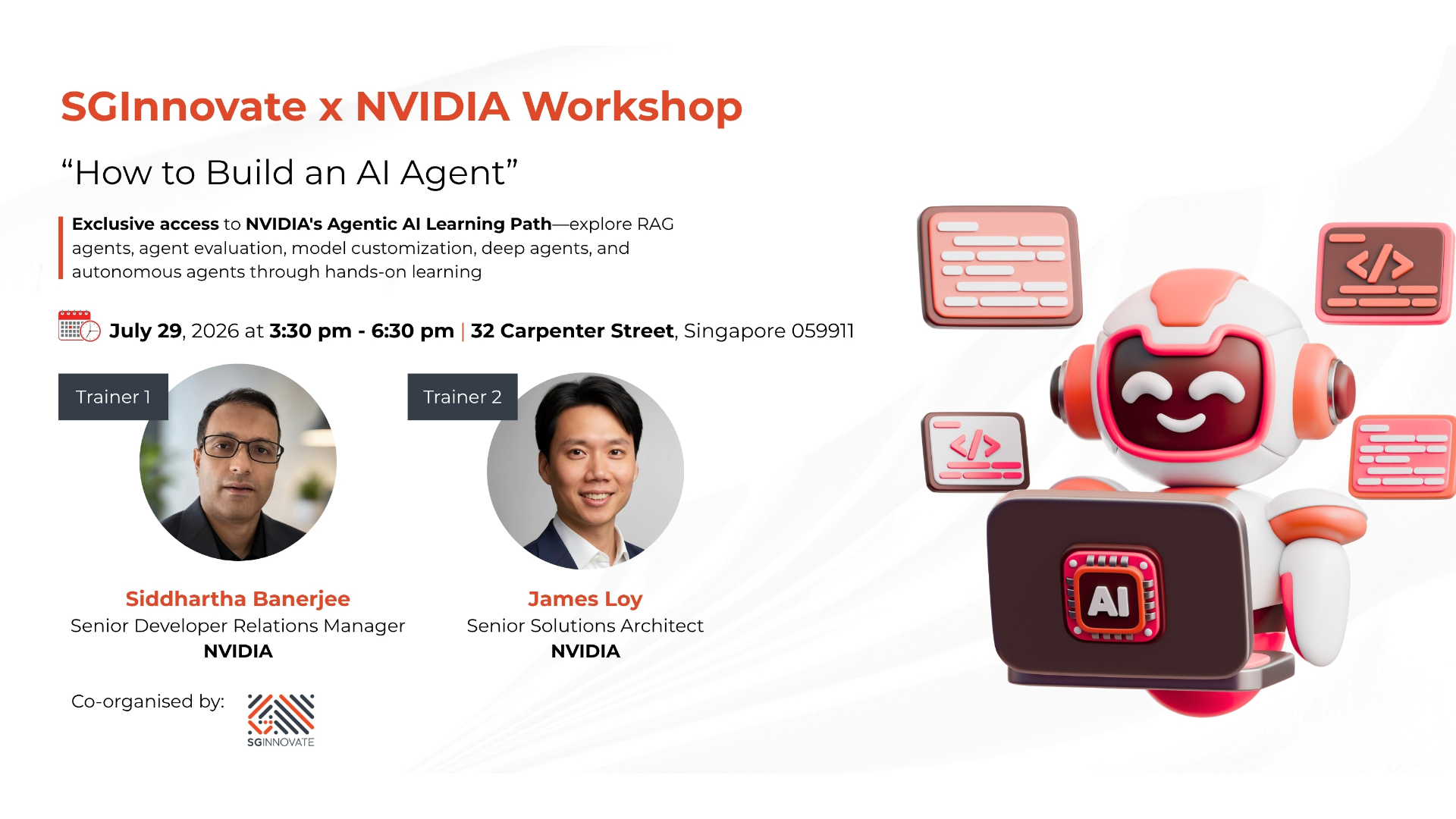
In this 3-hour workshop, participants will focus on 02 foundational capabilities of agentic AI: building agents and Agentic RAG. You'll create a Report Generation Agent that can research topics and generate detailed reports, then build an IT Help Desk Agent that uses retrieval and reasoning to answer user questions from a knowledge base.
After the workshop, participants will receive exclusive access to continue the remaining 4 modules independently on NVIDIA Brev, covering advanced topics such as agent evaluation, reinforcement learning, deep agents, and agent safety.
Course Description & Learning Outcomes
Participants will benefit from two complementary learning experiences:
1. In-Person Hands-On Workshop (Registration Required)
Join a 3-hour workshop with NVIDIA experts’ guide, where you'll build and explore the first 02 modules of the learning path through guided hands-on exercises.
2. Continue Learning at Your Own Pace
After the workshop, participants will receive exclusive access to the complete learning path, including remaining 4 modules. Continue exploring advanced topics such as agent evaluation, customization, deep agents, and agent safety through self-paced learning on NVIDIA Brev.
What Will Be Covered in the In-Person Workshop
Module 1: Build an Agent
Learn the fundamentals of AI agents by building a Report Generation Agent from scratch.
What you'll build: An intelligent system that researches any topic, creates outlines, writes detailed sections, and compiles professional reports automatically.
Key concepts:
The four core components of any AI agent (Model, Tools, Memory, Routing)
ReAct architecture for tool-calling agents
Building agents from scratch and with LangChain
Using NVIDIA Nemotron models
Module 2: Agentic RAG
Evolve from basic RAG to intelligent agentic RAG systems.
What you'll build: An IT Help Desk agent that dynamically decides when and how to search knowledge bases to answer user queries.
Key concepts:
Traditional RAG limitations and how agents solve them
NVIDIA NeMo Retriever (embeddings and reranking)
Vector databases with FAISS
ReAct agents with retrieval tools
Continue Learning After the Workshop
Participants will receive access to the remaining modules in the learning path:
Module 3: Agent Evaluation
Master the art of measuring and improving agent performance.
What you'll learn: How to systematically evaluate agents using industry-standard metrics, LLM-as-a-judge techniques, and NVIDIA models.
Module 4: Agent Customization
Specialize agents for specific domains using synthetic data and reinforcement learning.
What you'll build: A bash agent customized into a LangGraph CLI expert using NVIDIA NeMo Data Designer for synthetic data generation and GRPO (Group Relative Policy Optimization) for training.
Module 5: Deep Agents
Build autonomous agents that handle complex, multi-step tasks with planning and delegation.
What you'll build: A production-grade deep agent with explicit planning, hierarchical sub-agent delegation, persistent memory, and sandboxed execution using Docker.
Module 6: Agent Safety
Build an OpenClaw personal assistant agent that executes inside and outside of an Openshell sandbox, complete with network and filesystem policies that demonstrate how the NVIDIA NemoClaw reference stack improves agent security.
By completing 06 modules, you'll be able to:
Build agents that use tools, maintain context, and make intelligent decisions
Implement RAG systems that dynamically retrieve and use information
Evaluate agent quality using quantitative metrics and qualitative assessment
Use NVIDIA technology including NIM, Nemotron models, and NeMo Retriever
Customize agents through synthetic data generation and reinforcement learning
Build deep agents with planning, delegation, and sandboxed execution
Secure agents with kernel-level enforcement, data classification, and red-team evaluation
Deploy and monitor agents in production environments
Continuously improve agent performance through systematic evaluation
Recommended Prerequisites
This workshop is designed for beginner to intermediate developers with basic Python knowledge who want to start building AI-powered applications.
Participants should have:
Basic Python programming (writing simple scripts, functions, and working with libraries)
Basic understanding of how APIs work (request/response concept)
Familiarity with using large language models in practical applications (e.g., prompting or API usage)
Basic familiarity with the command line/terminal (navigating directories, running scripts and executing simple shell commands)
Pre-course instructions
Create your account and get API key: https://build.nvidia.com/ (instruction for API Key will be delivered to you once you’ve registered)
Create your account on https://brev.nvidia.com/ to launch the course during the workshop
Bring your laptop as there will be hands-on work
Schedule
Date: 29 Jul 2026, Wednesday
Time: 3:30 PM - 6:30 PM (GMT +8:00) Kuala Lumpur, Singapore
Location: 32 Carpenter Street, 059911
Skills Covered
PROFICIENCY LEVEL GUIDE
Beginner: Introduce the subject matter without the need to have any prerequisites.
Proficient: Requires learners to have prior knowledge of the subject.
Expert: Involves advanced and more complex understanding of the subject.
- API Development (Proficiency level: Beginner)
- Python (Proficiency level: Proficient)
- Understand of LLM/RAGS (Proficiency level: Proficient)
Speakers
Trainer's Profile:
Siddhartha Banerjee, Senior Developer Relations Manager, NVIDIA
Siddhartha Banerjee is an AI Technologist at NVIDIA. His journey in AI began during his PhD, where he built multi-step abstractive text-summarization systems well before today’s generative AI era. Over more than a decade in the field, he has built and led AI systems across India, the US, and Singapore, spanning document understanding, multilingual search, recommendations, trust and safety, Generative AI, and emerging agentic AI. He brings a blend of technical depth and global product experience, with a practical focus on helping teams understand and apply AI to real-world problems
Trainer's Profile:
James Loy, Senior Solutions Architect, NVIDIA
James Loy is a Senior Solutions Architect at NVIDIA, where he helps enterprises adopt and scale generative AI solutions using NVIDIA platforms, frameworks, and libraries such as NeMo and NIM. He has extensive experience working with organizations across industries to design and implement AI-driven transformation initiatives. James is the author of a book and numerous articles on artificial intelligence, machine learning, and data science. He holds a Master's degree in Computer Science from Georgia Tech.